

Ross Downing GMC of Gonzales

Blog

All Gonzales GMC Dealer Gonzales GMC Service Ross Downing GMC of Gonzales Service 2026 GMC Sierra 1500 Gonzales GMC Financing
2026 GMC Sierra 1500 Guide for Southeast Louisiana Truck Buyers
in 2026 GMC Sierra 1500

2026 GMC Sierra 1500 Guide for Southeast Louisiana Truck Buyers

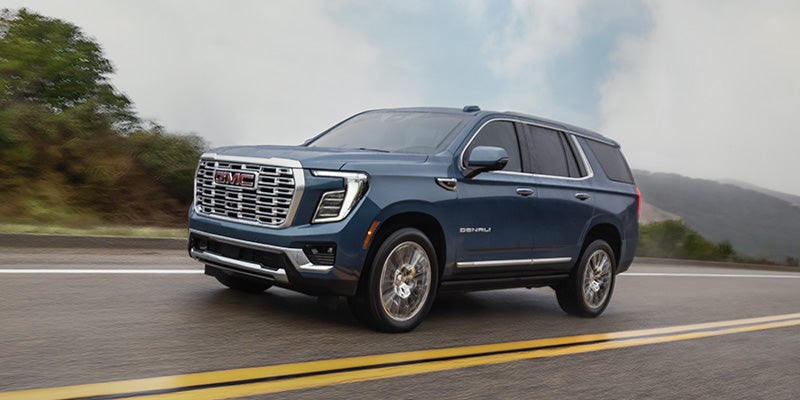
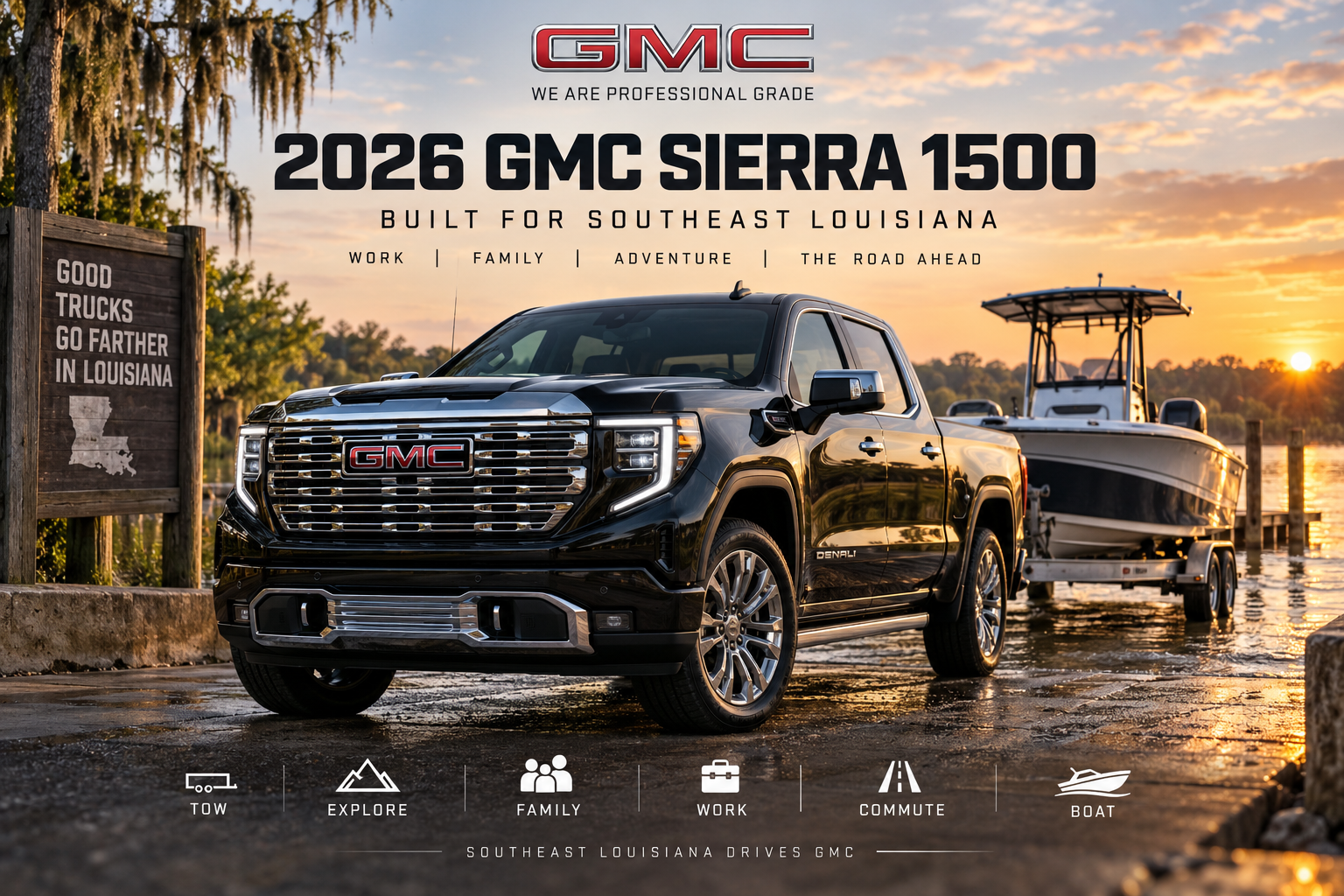
Shopping for a full-size truck in Southeast Louisiana means thinking about more than horsepower and appearance. A truck here may need to handle daily commuting, tow a boat, carry equipment to a jobsite, travel rural roads, make regular trips along I-10 or I-12, or serve as the family vehicle on the weekend. The 2026 GMC Sierra 1500 gives buyers a wide range of configurations, including multiple engines, cab styles, drivetrains and trim levels. Depending on configuration, shoppers can choose from work-focused models such as the Sierra Pro, off-road-oriented trims such as the AT4 and AT4X, and luxury-focused models such as Denali and Denali Ultimate. For truck shoppers in Hammond, Gonzales, Baton Rouge, Prairieville, Denham Springs, Covington, Mandeville, Slidell, Livingston Parish, Tangipahoa Parish, Ascension Parish and surrounding Southeast Louisiana communities, this guide explains the Sierra 1500 features and configurations worth comparing. Is the 2026 GMC Sierra 1500 a Good Truck for Southeast Louisiana? The 2026 GMC Sierra 1500 is worth considering for Louisiana drivers who want a full-size pickup that can combine everyday comfort with towing capability, available four-wheel drive, useful cargo-bed configurations and premium technology. Depending on trim and equipment, the Sierra 1500 offers: Multiple gasoline and diesel engine choices Up to 13,300 pounds of available maximum diesel towing capacity when properly equipped Crew Cab, Double Cab and Regular Cab configurations Available 2WD and 4WD Available GMC MultiPro Tailgate Available Super Cruise driver-assistance technology AT4 and AT4X off-road-oriented models Denali and Denali Ultimate luxury-focused models GMC lists the maximum available diesel towing capacity for the 2026 Sierra 1500 at 13,300 pounds when properly equipped. That rating applies only to specific configurations and should not be assumed to apply to every Sierra 1500. Trailering Note: Maximum trailering ratings vary by vehicle configuration, equipment, passengers, cargo and other factors. Always review the specific vehicle's trailering information, labels and owner's manual before towing. What Engines Are Available in the 2026 GMC Sierra 1500? The 2026 Sierra 1500 is available with several powertrain choices, giving buyers the ability to prioritize everyday driving, traditional V8 performance, towing or diesel capability. TurboMax Engine The TurboMax engine produces: 310 horsepower 430 lb-ft of torque GMC lists maximum available towing of up to 9,400 pounds when properly equipped for certain TurboMax configurations. For drivers who primarily commute, handle home projects, carry equipment or tow moderate loads, the TurboMax may be a useful configuration to compare. 5.3L EcoTec3 V8 The available 5.3-liter V8 gives Sierra buyers a traditional gasoline V8 option. It is standard on certain trims, including the 2026 Sierra 1500 SLT, where GMC pairs it with a 10-speed automatic transmission. This engine may appeal to shoppers who want familiar V8 characteristics while balancing everyday driving and truck capability. 6.2L V8 The available 6.2-liter V8 is offered in selected Sierra 1500 configurations and is especially relevant to shoppers considering higher-content trims. It may be worth comparing if stronger gasoline-engine performance is an important part of the buying decision. 3.0L Duramax Turbo-Diesel The available 3.0L Duramax Turbo-Diesel is especially relevant for buyers who regularly tow or spend substantial time on the highway. When properly configured, a 2026 Sierra 1500 equipped with the Duramax can achieve GMC's maximum advertised towing rating of up to 13,300 pounds. Which GMC Sierra 1500 Engine Is Best for Louisiana? There is no single engine that is best for every Louisiana driver. The more useful question is: How will you actually use the truck? Consider the TurboMax if: You primarily commute, drive locally, carry moderate loads or occasionally tow. Consider the 5.3L V8 if: You want a traditional gasoline V8 and a balance of everyday usability and capability. Consider the 6.2L V8 if: You prefer stronger gasoline-engine performance and are considering compatible Sierra configurations. Consider the 3.0L Duramax if: You tow frequently, drive substantial highway mileage or specifically prefer a diesel powertrain. For many buyers, choosing the right engine and capability package first can be more important than choosing a trim based on appearance alone. How Much Can a 2026 GMC Sierra 1500 Tow? The 2026 Sierra 1500 can tow up to 13,300 pounds when properly equipped, according to GMC. That number does not apply to every Sierra 1500. GMC states that the maximum rating is achieved with a specific configuration that includes a Double Cab, 2WD, standard bed, available 3.0L Duramax Turbo-Diesel, available Max Trailering Package and specified wheels and tires. Actual capability varies based on factors such as: Engine Cab configuration Bed length 2WD or 4WD Trailering equipment Wheel and tire configuration Optional equipment Passenger and cargo weight What Should You Know Before Buying a Sierra for Towing? If towing is one of the main reasons you are buying a truck, start by understanding the trailer you plan to pull. Know the: Loaded trailer weight Tongue weight Payload requirements Passenger weight Cargo weight Required hitch type Then compare those needs with the ratings for the specific truck you are considering. A model-line maximum should never be treated as the towing rating for every vehicle bearing the Sierra 1500 name. Is the Duramax Sierra 1500 Good for Towing Boats in Louisiana? The 3.0L Duramax Sierra 1500 can be a strong configuration to consider for drivers who regularly tow. That may include Louisiana boat owners hauling: Bass boats Bay boats Center-console boats Pontoon boats Fishing boats Utility trailers ATVs or side-by-sides The right configuration depends on the actual loaded weight of the boat, trailer, fuel and equipment. Always compare that weight against the trailering and payload information for the specific Sierra 1500 you are considering. What 2026 GMC Sierra 1500 Trims Are Available? The 2026 Sierra 1500 lineup includes: Pro SLE Elevation SLT AT4 AT4X Denali Denali Ultimate That range allows shoppers to prioritize work capability, appearance, off-road equipment, luxury or a combination of those factors. GMC Sierra 1500 Pro: Who Should Consider It? The Sierra Pro is the work-focused entry point into the lineup. It may be a logical starting point for: Contractors Fleet operators Small businesses Property owners Agricultural users Buyers who prioritize utility It is also available in Regular Cab configurations, which may appeal to buyers who do not need a second row. GMC Sierra 1500 SLE: A Well-Equipped Everyday Truck The SLE adds many of the technology and comfort features buyers expect in a modern personal-use pickup. Depending on equipment, shoppers can find features such as GMC's large infotainment display and digital Driver Information Center. The 3.0L Duramax Turbo-Diesel is also available on applicable SLE configurations. For someone who wants an everyday Sierra with more technology and convenience features than a basic work truck, the SLE is worth comparing. GMC Sierra 1500 Elevation: A Popular Style-Focused Choice The Sierra Elevation emphasizes a more distinctive appearance while retaining everyday truck usability. Standard exterior features include elements such as: Monochromatic exterior treatment Gloss-black grille details LED fog lamps 20-inch gloss-black painted aluminum wheels For shoppers who want aggressive styling without automatically moving into an off-road or luxury-focused trim, the Elevation may be a useful model to compare. GMC Sierra 1500 SLT: Premium Features with Traditional Truck Character The 2026 SLT includes the 5.3L V8 as standard equipment and offers additional convenience and premium features. The available Duramax diesel and trailering technology can make the SLT worth considering for buyers who want a well-equipped truck without moving into Denali territory. Is the GMC Sierra AT4 a Good Choice for Louisiana? The Sierra AT4 is designed for buyers who want additional off-road-oriented equipment. Standard equipment includes features such as: 2-inch factory suspension lift Off-road suspension Rancho monotube shocks Two-speed transfer case Underbody skid plates Automatic locking rear differential The 3.0L Duramax Turbo-Diesel is standard on the 2026 AT4. Those features may be useful for drivers who regularly travel: Hunting property Camps Gravel roads Rural property Muddy worksites Boat launches Unimproved roads What Is the Difference Between Sierra AT4 and AT4X? The AT4 and AT4X are both off-road-oriented Sierra trims, but the AT4X adds more specialized equipment. Depending on configuration, the AT4X includes features such as: Multimatic DSSV dampers Front electronic locking differential Rear electronic locking differential Additional underbody protection For buyers who mainly want meaningful off-road capability while retaining everyday usability, AT4 may be worth comparing first. For those who place greater emphasis on specialized off-road hardware, AT4X may deserve additional consideration. GMC Sierra Denali: Who Should Consider It? Sierra Denali combines full-size pickup capability with a more luxury-focused interior and exterior. Depending on configuration, features include: Signature Denali exterior styling Genuine wood interior trim Aluminum trim Leather seating surfaces Power-adjustable front seats Available advanced driver-assistance technology It may be particularly appealing to drivers who use their truck for both professional and personal transportation. What Is Sierra Denali Ultimate? Denali Ultimate sits at the top of the Sierra 1500 trim range. Equipment includes features such as: 6.2L V8 Super Cruise Heated and ventilated front seats Massage functionality Premium Bose audio Distinctive Denali Ultimate interior and exterior treatments The 3.0L Duramax Turbo-Diesel is also available in applicable configurations. For buyers prioritizing luxury, technology and premium interior appointments, it is worth comparing Denali Ultimate with Denali to determine whether the added equipment matches their needs. Crew Cab vs. Double Cab vs. Regular Cab Cab configuration can significantly affect passenger space and how the truck is used. Crew Cab Crew Cab is generally the configuration to compare first for: Families Frequent rear-seat passengers Road trips Daily commuting Buyers prioritizing passenger room GMC lists approximately 43.4 inches of second-row legroom in the Crew Cab. Double Cab Double Cab may make sense for buyers who want four doors and rear seating but do not require as much second-row space. GMC lists approximately 35.24 inches of second-row legroom in the Double Cab. Regular Cab Regular Cab configurations may be worth considering for dedicated work use when rear seating is unnecessary. 2WD or 4WD Sierra 1500: Which Makes More Sense in Southeast Louisiana? The right drivetrain depends on how and where you drive. A 2WD Sierra may make sense if: Most of your driving takes place on paved roads and highways and you rarely encounter low-traction conditions. A 4WD Sierra may be worth considering if: You frequently travel to: Hunting leases Camps Farms Construction sites Muddy property Gravel roads Boat launches Unimproved roads Drivetrain selection can also affect towing, payload, fuel consumption and vehicle price, so it should be treated as a functional decision rather than simply an appearance preference. Is the GMC MultiPro Tailgate Useful? The available GMC MultiPro Tailgate offers multiple positions intended to improve bed access and cargo usability. Depending on how the truck is used, it can assist with: Accessing the bed Loading equipment Managing longer cargo Creating a work surface Organizing items in the bed For buyers who use their pickup bed frequently, tailgate functionality may deserve as much attention as interior technology. What Technology Does the 2026 Sierra 1500 Offer? Depending on trim and equipment, available Sierra technology includes: 13.4-inch infotainment display 12.3-inch Driver Information Center Head-Up Display Google built-in compatibility Trailering technologies Camera views Wireless phone connectivity Super Cruise driver-assistance technology GMC states that available Sierra configurations offer more than 40 diagonal inches of combined driver-focused digital display area. What Is Super Cruise on the GMC Sierra? Super Cruise is GMC's available hands-free driver-assistance technology for compatible roads and operating conditions. It is available on certain Sierra configurations and included on Denali Ultimate. Super Cruise is a driver-assistance system, not an autonomous-driving system. Drivers must remain attentive, follow system requirements and remain responsible for vehicle operation at all times. Which Sierra 1500 Is Worth Comparing for Commuting Between Hammond and Baton Rouge? For frequent highway driving, shoppers may want to prioritize: Comfortable seating Crew Cab passenger space Engine choice Driver-assistance features Highway-oriented tires Infotainment technology Fuel consumption Depending on budget and desired equipment, Elevation, SLT and Denali may all be worth comparing. Buyers who accumulate substantial highway mileage may also want to compare the 3.0L Duramax with gasoline configurations based on their actual driving habits. Which Sierra 1500 Should Frequent Towers Compare? Buyers who tow frequently may want to compare several configurations. 3.0L Duramax Worth considering for frequent or heavier conventional towing. 5.3L V8 A traditional gasoline option available across multiple configurations. 6.2L V8 Worth comparing for buyers who prefer stronger gasoline-engine performance. The engine alone does not determine towing capability. Cab style, drivetrain, bed length, trailering equipment and other options all influence the rating for an individual truck. Which Sierra 1500 Is Worth Comparing for Hunting or Camp Use? For many Louisiana buyers, the AT4 may be a logical starting point. Its factory lift, 4WD-oriented hardware, skid plates and off-road suspension may provide useful capability for hunting property, camps and rural roads. For more demanding terrain, shoppers may also want to compare the AT4X and its additional off-road hardware. Which Sierra 1500 Is Worth Comparing for Contractors? For dedicated fleet or work use, Sierra Pro is a logical starting point. For mixed professional and personal use, SLE, Elevation or SLT may be worth comparing. For owners or managers who place greater emphasis on premium interior appointments, Denali may also make sense. The most suitable configuration depends on payload needs, towing requirements, passenger use and equipment preferences. Which Sierra 1500 Is Worth Comparing for Families? For families, a Crew Cab is generally the first configuration worth evaluating because it provides more rear-seat room than the Double Cab. GMC lists approximately 43.4 inches of second-row legroom in Crew Cab models compared with 35.24 inches in Double Cab models. Possible starting points include: Family + everyday driving: Elevation Family + frequent towing: Duramax Crew Cab Family + off-pavement use: AT4 Crew Cab Family + premium comfort: Denali Crew Cab These are starting points rather than universal recommendations. Sierra Elevation vs. AT4: Which Should You Compare? Consider Elevation if your priorities are mainly: Styling Daily driving Technology Everyday usability Consider AT4 if your priorities include: 4WD capability Hunting property Camps Off-pavement travel Factory lift Underbody protection The best choice depends on whether the AT4's additional off-road equipment is useful for the way you actually drive. Sierra AT4 vs. Denali: What's the Difference? These trims emphasize different priorities. AT4 More focused on off-road-oriented capability and rugged styling. Denali More focused on luxury, interior materials, comfort and technology. A driver who regularly travels camp roads or rural property may place greater value on AT4 equipment. A driver spending most of their time on highways and paved roads may prioritize the comfort and interior treatment of Denali. Sierra Denali vs. Denali Ultimate Denali provides a high level of premium equipment. Denali Ultimate adds additional technology, seating features and distinctive design details. The better choice depends on whether those additional features provide enough value for the individual buyer. Should You Buy a Gas or Diesel GMC Sierra 1500 in Louisiana? Start with four questions: How much do you tow? How often do you tow? How much highway driving do you do? How long do you plan to keep the truck? The Duramax may become more attractive when towing and highway use are major parts of ownership. For buyers primarily making shorter local trips with lighter towing needs, a gasoline engine may be worth comparing first. There is no universal rule that diesel is automatically the better choice. What Should You Check During a Sierra 1500 Test Drive? A useful test drive should involve more than driving around the block. Pay attention to: Visibility Can you comfortably judge the truck's dimensions? Seat Position Are you comfortable behind the wheel? Rear-Seat Space If passengers will regularly ride in the back, sit there yourself. Ride Quality Compare trims if possible, especially conventional models versus AT4 or AT4X. Engine Response Drive the engine you are actually considering. Parking Try backing into a parking space and using the available camera systems. Technology Connect your phone and use the infotainment system. Bed Access Open the tailgate and see how easy it is to access the cargo bed. Questions to Ask Before Buying a GMC Sierra 1500 Before choosing a particular truck, ask: What exact engine does this truck have? Is it 2WD or 4WD? What cab configuration does it have? What bed length does it have? What is this specific truck's trailering rating? What is its payload rating? Does it have the Max Trailering Package? Which driver-assistance features are included? Does it have the MultiPro Tailgate? Are dealer-installed accessories included? Which factory warranties apply? Are any available incentives subject to eligibility requirements? These questions make it easier to compare individual trucks accurately. Frequently Asked Questions About the 2026 GMC Sierra 1500 How much can a 2026 GMC Sierra 1500 tow? The 2026 Sierra 1500 can tow up to 13,300 pounds when properly equipped. Actual towing capacity varies by configuration. Which Sierra engine provides the highest advertised maximum towing capacity? The available 3.0L Duramax Turbo-Diesel is used in the Sierra 1500 configuration that achieves GMC's maximum advertised rating of up to 13,300 pounds when properly equipped. How much can the TurboMax Sierra 1500 tow? GMC lists maximum available towing of up to 9,400 pounds when properly equipped for certain TurboMax configurations. Does the Sierra 1500 offer a V8? Yes. Applicable 2026 Sierra 1500 configurations are available with 5.3L and 6.2L V8 engines. Does the Sierra 1500 offer a diesel engine? Yes. The available 3.0L Duramax Turbo-Diesel is offered on multiple Sierra 1500 configurations. Does the Sierra AT4 come with the Duramax diesel? Yes. The 3.0L Duramax Turbo-Diesel is standard on the 2026 Sierra 1500 AT4. What is the difference between Sierra AT4 and AT4X? The AT4X adds more specialized off-road hardware, including Multimatic DSSV dampers and front and rear electronic locking differentials. What is the most premium Sierra 1500 trim? Denali Ultimate sits at the top of the 2026 Sierra 1500 trim range. Does the Sierra 1500 offer Super Cruise? Yes. Super Cruise is available on certain Sierra configurations and included on Denali Ultimate. It remains a driver-assistance technology and does not replace driver attention or responsibility. Which Sierra cab has the most rear-seat space? The Crew Cab provides more rear-seat legroom than the Double Cab. GMC lists approximately 43.4 inches for Crew Cab versus 35.24 inches for Double Cab. Can a Sierra 1500 tow a camper? Many configurations can tow recreational trailers, but buyers should compare the camper's loaded weight and tongue weight with the specific truck's trailering and payload ratings. Can a Sierra 1500 tow a fifth-wheel or gooseneck trailer? Certain configurations can. GMC lists maximum available fifth-wheel/gooseneck towing of up to 9,900 pounds when properly equipped for a specific 2026 configuration. Is 2WD or 4WD better for Louisiana? That depends on usage. Buyers who primarily drive paved roads may find 2WD sufficient, while drivers who regularly visit camps, hunting leases, muddy jobsites or unimproved roads may prefer 4WD. Which Sierra 1500 trim offers a good balance of styling and everyday usability? The Elevation is one configuration worth comparing because it combines distinctive styling with features aimed at personal-use truck buyers. The best trim still depends on budget and intended use. Finding the Right GMC Sierra 1500 in Southeast Louisiana The smartest way to shop for a Sierra 1500 is not simply to ask: “Which Sierra is best?” A better question is: “Which Sierra best matches the way I actually use a truck?” A contractor in Hammond may need a very different configuration from a commuter in Prairieville. A boat owner in Gonzales may prioritize trailering equipment and engine choice. A hunter heading to camp may place more value on AT4 equipment. A driver regularly traveling between Baton Rouge and the Northshore may prioritize interior comfort and highway technology. And someone who tows frequently may care much more about engine, trailering equipment and payload than exterior trim. That is why the engine, drivetrain, cab, bed and equipment package should be considered together. Shopping for a GMC Sierra 1500 in Southeast Louisiana? Start by identifying three things: What you need to tow. How you normally drive. Which features you will actually use. From there, compare available Sierra 1500 inventory by engine, cab, drivetrain, bed configuration and equipment. That approach can make it much easier to identify a truck that fits the way you plan to use it throughout Southeast Louisiana. Vehicle Information Disclaimer Vehicle specifications, features, ratings, availability and equipment may vary by trim, configuration and individual vehicle and are subject to change by the manufacturer. Trailering and payload ratings vary based on vehicle configuration, equipment, passengers, cargo and operating conditions. Always review the specific vehicle's labels, owner's manual and manufacturer trailering information before towing. Images, examples and equipment descriptions may refer to optional or unavailable features. Contact a Ross Downing GMC representative for information regarding a specific vehicle. This version also avoids the high-risk advertising areas the FTC is currently scrutinizing—such as misleading vehicle prices, unavailable rebates, required fees omitted from advertised pricing, required down payments, and financing-dependent advertised prices—because the article makes no pricing, payment, APR, savings or guaranteed-discount claims. Louisiana law likewise prohibits false or misleading dealership advertising, so keeping the piece factual, qualified and free of unsupported superlatives is the safer approach.

Read More
How Long Does It Take to Charge an Electric Car at Home

How Long Does It Take to Charge an Electric Car at Home

How long does it take to charge an electric car at home in Gonzales? Charging time comes from two numbers: battery energy needed and available home charging power. Therefore, one universal hour estimate cannot describe every charging session. In addition, a short commute may need only a modest refill. A long trip may require many more kilowatt hours before morning. Home Charging Time Starts With Charging Level Home AC charging uses either a 120 volt Level 1 source or a 240 volt Level 2 source. Level 1 sends power slowly through a standard household outlet. By contrast, Level 2 uses a higher voltage and can deliver far more power. Charging power is measured in kilowatts. Battery energy is measured in kilowatt hours. Therefore, a charger rated at more kilowatts can add energy faster when the GMC EV can accept that rate. Moreover, the EV also sets an AC charging limit. For this reason, a wall charger cannot force more power into the battery than the onboard charger accepts. The final rate follows the lower supported number between the charging equipment and the EV. That detail matters for GMC models with large battery packs. A HUMMER EV or Sierra EV can need substantial energy after a long trip. However, the same model may need only a small refill after local errands. How Long Does Level 1 Charging Take at Home? Level 1 charging uses 120 volt AC power and delivers relatively low charging power. GMC's Dual Level Charge Cord can use a standard outlet at up to 1.4 kW. Therefore, at that rate, charging happens gradually across many hours. The EPA estimates Level 1 can add roughly three to five miles of range each hour. Therefore, twelve hours plugged in may replace about 36 to 60 miles under favorable circumstances. That estimate works best as a planning range, not a promise. Battery temperature, outlet quality, charging settings, and energy losses can change what reaches the battery. Still, Level 1 can cover short daily mileage when the EV remains plugged in overnight. Consider a Gonzales owner who drives 25 miles between home, work, school, and errands. Level 1 may replace much of that energy before morning. However, a driver covering 80 miles each day may recover too slowly for the same routine. Level 1 also gives owners a simple entry point. No dedicated 240 volt circuit is needed when an approved household outlet is available. Even so, the outlet should be in good condition and suitable for continuous charging loads. How Much Faster Is Level 2 Charging? Level 2 charging uses 240 volt AC power and delivers far more energy each hour. GMC supports several home charging rates through compatible equipment and EV hardware. The Dual Level Charge Cord can provide up to 7.7 kW from a compatible 240 volt source. GM PowerUp 2 can provide up to 11.5 kW when properly hardwired. Some compatible GMC EV setups can support still higher AC charging rates. Therefore, Level 2 can replace a large share of daily energy during one overnight parking period. EPA guidance places many Level 2 setups near 25 to 40 miles of added range each hour. A 7.7 kW setup and an 11.5 kW setup will not refill the same battery at identical speeds. The higher power source can add more energy each hour when the EV supports it. Consequently, charger selection should start with the model's AC charging limit. The electrical circuit matters too. Higher output equipment may require hardwiring and a dedicated circuit. In addition, the home's electrical panel must have enough available capacity for the planned charging load. For many GMC EV owners, Level 2 fits overnight charging well. It can restore energy from longer commutes or repeated family trips before the next morning. Still, the correct rate should match the EV, the house, and the owner's mileage. What Changes a GMC EV Charging Estimate The charging estimate can move after you plug in because several inputs change during the session. Battery state is the first major input. A battery at 70 percent needs far less energy than one at 20 percent. Charging equipment is another input. Therefore, switching from Level 1 to Level 2 can cut the time needed for the same energy refill. The EV's onboard AC limit also caps the incoming power. Temperature can change charging speed as well. Batteries charge differently when they are very hot or cold. As a result, the EV may adjust charging power while it manages battery temperature. Charging settings also matter. A scheduled charging window can delay the start time. Likewise, a selected charge target may stop charging before the battery reaches 100 percent. The displayed finish time can change as these inputs change. However, that does not mean something is wrong. The estimate updates as the EV reads battery needs and available power. For this reason, owners should compare repeated charging patterns instead of focusing on one night. A week of normal charging gives a clearer view of how long the household routine needs. Plan a Gonzales Home Charging Setup Around Daily Miles Home charging works best when the setup matches the miles you need to replace between trips. Start by estimating how far the GMC EV travels on a normal weekday. Then note how many hours it usually remains parked at home. A short commute may need only a small nightly refill. Therefore, Level 1 may cover the schedule for some owners. Longer commutes or frequent evening trips may point toward Level 2. Next, check the GMC EV's supported AC charging rate. Then compare that number with the charging equipment under consideration. A charger with a larger rating will not exceed the EV's own AC limit. An electrician should inspect the home before higher power Level 2 equipment is installed. The inspection can cover panel capacity, circuit size, wiring, breaker requirements, and charger location. In addition, hardwired installation may support higher output than a portable cord setup. Think about where the charging cable will reach each night. The parking position, charger location, and cable path should make plugging in easy. Therefore, installation planning should include the driveway or garage layout, not only electrical ratings. The most useful charging plan is the one that restores the energy your household uses between trips. You may not need an empty to full charge every night. Instead, home charging can work like replacing the miles you used that day. For Gonzales GMC EV owners, the answer starts with daily miles, charging hours, and available home power. Level 1 can serve lighter travel schedules. Level 2 can restore energy much faster for longer routes and larger battery needs. Therefore, matching the charger to your routine can make overnight charging simple and predictable.
GMC Financing Gonzales Questions to Ask Before Signing

GMC Financing Gonzales Questions to Ask Before Signing

GMC financing Gonzales customers can review several figures before signing a final contract. The process includes lender terms, trade figures, cash down, optional products, and required disclosures. Therefore, reviewing each number before signing gives you a clearer view of the transaction. A monthly payment matters, but it is only one part of the agreement. You also need to know how much you are borrowing, how long repayment lasts, and what credit will cost. Know What the Finance Office Is Finalizing Additionally, the finance office completes the documents that connect your vehicle purchase with the chosen loan. It may also present lender options, service contracts, GAP products, and other optional items. Therefore, this stage brings several financial decisions into one conversation. Dealer arranged financing means the dealership submits your credit application to one or more lenders. Still, a lender may approve the application with a specific APR, term, and payment structure. In addition, you may already have an offer from a bank or credit union. Comparing those offers gives you a clearer view of the available terms. What should you ask before the paperwork is complete? Start by confirming the lender, loan term, APR, amount financed, and payment schedule. Then review any product or fee that changes the final balance. Because each figure connects to the others, one change can alter the amount you repay. The finance office should also provide the disclosures tied to the credit agreement. Moreover, these documents show the core loan figures in one place. Therefore, use them as a reference while checking the final contract against the terms discussed earlier. What Should You Check Beyond the Monthly Payment? The full loan cost includes the APR, finance charge, amount financed, payment schedule, and loan term. These figures explain what you borrow and what repayment costs across the agreement. A lower monthly payment can come from stretching repayment across more months. However, a longer term can increase total interest even when the payment looks easier to manage. Therefore, compare the payment with the number of months and the finance charge. APR deserves separate attention because it describes the yearly cost of credit. The stated interest rate may look similar, but APR can reflect certain required finance charges. In addition, the amount financed shows how much credit the lender provides after the transaction figures are combined. For this reason, ask to see the Truth in Lending disclosure before signing. Then confirm the APR, finance charge, amount financed, total payments, and payment schedule. If one number differs from what you expected, ask for an explanation before continuing. The strongest question is not whether the payment fits this month. Instead, ask what the loan costs from the first payment through the last. That perspective keeps the full agreement visible. Are the Extra Products Part of Your Loan? Optional products can increase the principal balance when their prices are financed. That means the product cost can also accrue interest through the loan. Common products can include GAP coverage, service contracts, tire protection, or other vehicle protection plans. However, each product should have a stated price and clear terms. Ask whether the item is optional, what it covers, and how cancellation works. If you choose a product, confirm whether you are paying for it in cash or adding it to the loan. In addition, ask how the added amount changes the financed balance and monthly payment. A small payment increase can represent a much larger total cost across a long term. Additionally, review every product line separately before signing. Do not rely on a combined monthly figure to explain several items at once. Therefore, ask for the individual price of each product and compare that price with the coverage provided. You should also keep copies of any product agreements you accept. Those documents explain coverage limits, exclusions, claim procedures, and cancellation rules. Reading them alongside the finance contract gives you a clearer record of what you purchased. Verify Trade and Cash Figures Trade value, payoff amount, cash down, and rebates all change the final amount financed. These figures should be reviewed together because each one changes the transaction math. First, start with the agreed trade allowance. Then compare that figure with the payoff on your current loan, if one remains. Positive equity can reduce the next financed balance. By contrast, a payoff above the trade allowance can add remaining debt to the new transaction. Cash down should appear clearly in the paperwork. The same applies to any rebate or credit used toward the purchase. Therefore, confirm each amount before reviewing the final financed balance. A useful review sequence keeps the calculation organized: Confirm the vehicle selling price shown in the agreement. Confirm the trade allowance and any remaining payoff. Confirm cash down, rebates, and other credits. Confirm the resulting amount financed before accepting the loan. These figures should match the deal you discussed. If the final amount financed looks unfamiliar, trace each line before signing. That review can reveal where taxes, fees, products, trade figures, and cash entries changed the total. Match the Contract to the Deal Before Signing Moreover, the final contract should reflect the terms you agreed to before signatures begin. This review is your chance to compare the paperwork with the numbers discussed during the transaction. Start with the selling price and trade figures. Then confirm cash down, rebates, optional products, and fees. Next, review the lender, APR, loan term, amount financed, finance charge, and payment schedule. Because these figures connect, a change in one area can alter several others. Ask about any line you do not recognize. A clear explanation should identify what the charge covers and whether it is required or optional. In addition, confirm that any product you declined does not appear in the final agreement. Take enough time to read each document before signing it. You can also compare the final paperwork with earlier worksheets or written figures. Therefore, keep those materials available until the transaction is complete. Before leaving, request copies of every signed document and any product agreement you accepted. Those records give you the terms, payment information, and coverage details in writing. Careful review before signing keeps the focus on the exact agreement you are accepting.

GMC SUV Acadia and Yukon XL for Gonzales Lifestyles

GMC SUV Acadia and Yukon XL for Gonzales Lifestyles

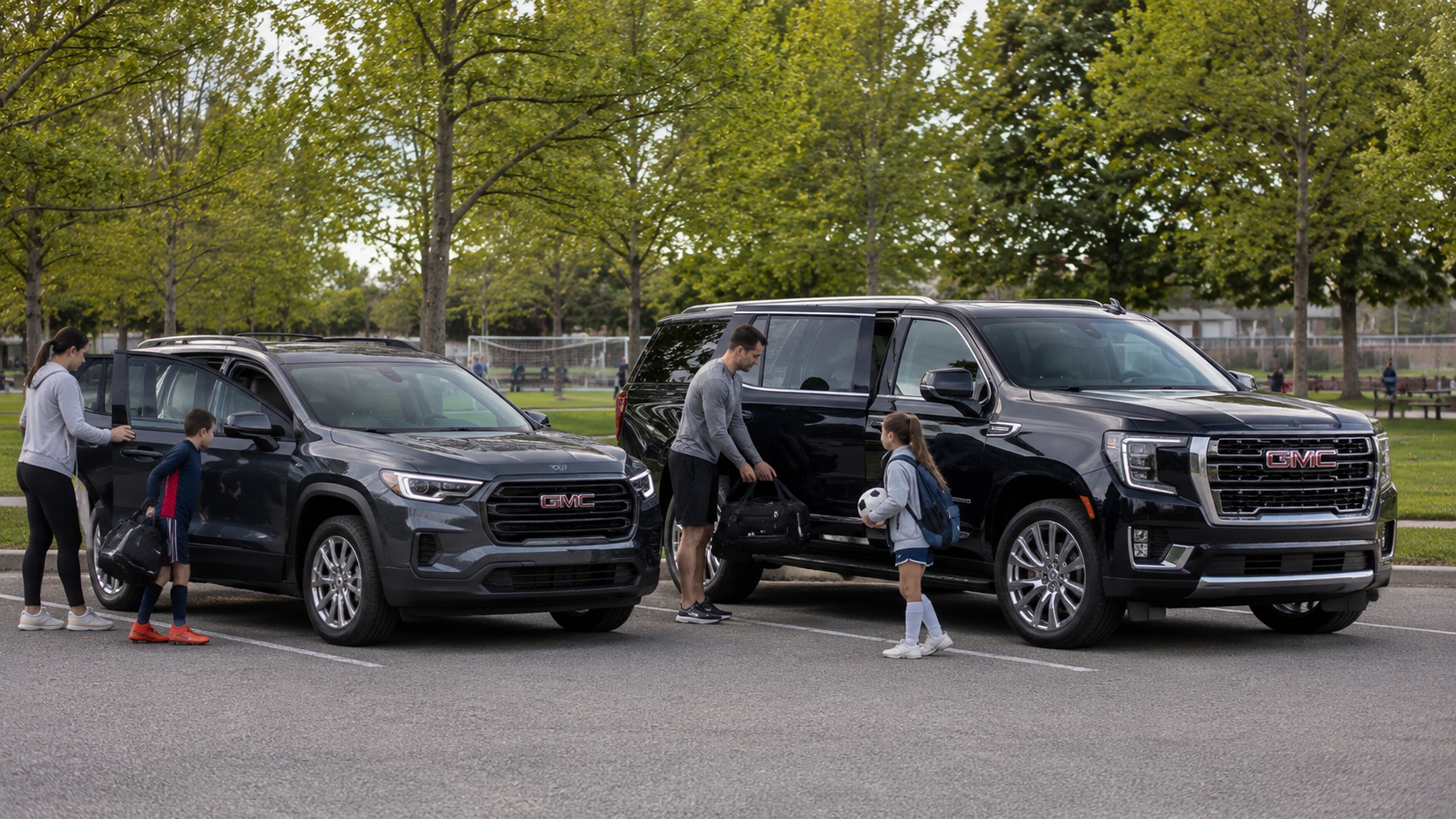
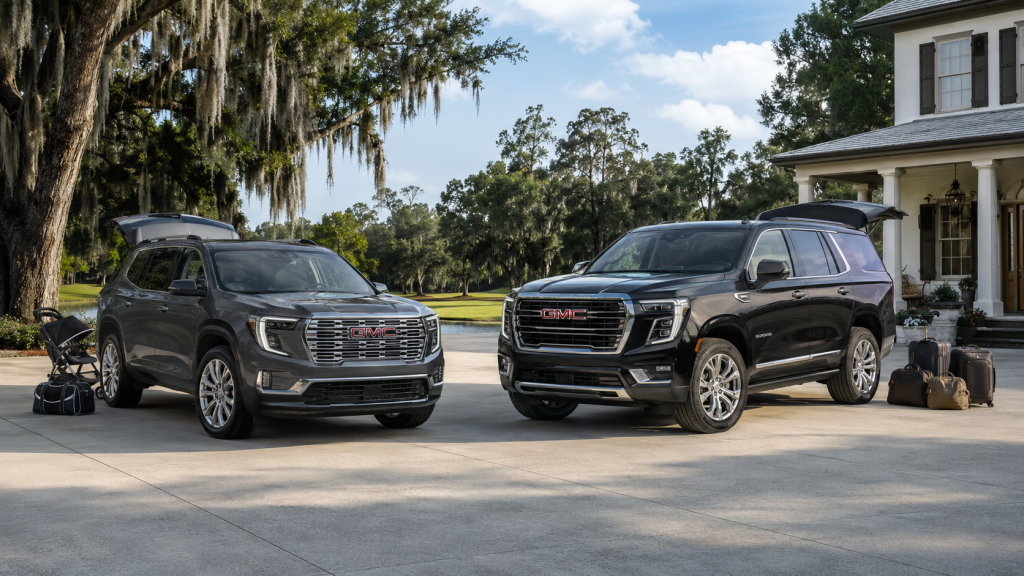
GMC SUV Acadia and Yukon XL choices can lead Gonzales families toward very different daily driving routines. Both provide three rows and room for up to eight with the right seating layout. However, they occupy very different amounts of road, driveway, and garage space. Therefore, your weekly schedule should guide the comparison from the start. In addition, passenger count matters alongside cargo needs, parking spaces, commute miles, and trip frequency. How Much SUV Do You Want to Drive Every Day? The GMC Acadia is a midsize three row SUV with a shorter exterior footprint. The Yukon XL is a full size three row SUV with far more overall length. That size gap changes how each one fits into a normal weekday. The Acadia measures about 204 inches long. By contrast, the Yukon XL stretches about 225 inches. Therefore, the larger GMC needs roughly 21 more inches from front to rear. That extra length supports a larger cabin and much more cargo room. Still, added length changes parking and garage planning. As a result, a shorter SUV takes less room inside crowded lots and narrow residential spaces. In addition, it can leave more clearance around garage doors, shelves, bikes, and stored equipment. Do you need eight seats or simply three rows? Both GMC models can answer that passenger question. However, row count alone does not settle the size question. The stronger match comes from how frequently you fill those seats and how much space surrounds them. Daily Driving and Parking Around Gonzales Daily driving puts exterior size into context faster than a specification sheet. School pickup, grocery runs, medical appointments, and restaurant parking all involve repeated low speed maneuvering. Therefore, overall length becomes part of every normal trip. The Acadia keeps three rows within a midsize body. That can make it easier to place between parking lines or back from tighter spaces. By contrast, the Yukon XL trades compact dimensions for a much larger interior. Camera views and parking sensors can reduce some difficulty. However, technology does not shorten the body. You still need enough room to turn, stop, and open doors around nearby vehicles. Garage dimensions deserve the same attention. Measure usable depth instead of relying on the listed garage size. Shelving, freezers, tools, and storage bins can reduce the clear area around the SUV. For this reason, a driveway check can reveal more than an exterior dimension table. Families who spend most weekdays moving through Gonzales may favor the Acadia's smaller footprint. By contrast, households with more parking room may accept the Yukon XL's added size easily. The decision should reflect the places you visit every week. How Much Cargo Room Stays Available With Three Rows? Cargo volume behind row three measures storage while every passenger row stays ready. That figure gives family travel a more useful starting point than maximum volume alone. Therefore, it deserves close attention before any rear seat gets folded. The Acadia provides about 23 cubic feet behind its third row. The Yukon XL provides about 41.5 cubic feet behind its third row. That leaves the larger GMC with about 18.5 extra cubic feet while all three rows remain available. What does that mean during a full passenger trip? The extra room can hold more luggage, sports bags, groceries, or stroller gear. However, a household that rarely fills row three may not need that much space every day. Fold the Acadia's third row and cargo room rises to about 57.3 cubic feet. With more seats folded, maximum cargo volume reaches about 97.5 cubic feet. In the Yukon XL, those figures rise to about 93.6 and 144.5 cubic feet. Therefore, cargo frequency matters as much as cargo volume. Large travel loads every month support the case for Yukon XL space. Smaller weekly loads can make Acadia storage easier to justify. Fuel and Price Across Your Weekly Schedule Fuel economy and starting price create another large separation between these GMC SUVs. The Acadia uses a turbocharged four cylinder engine and carries higher gasoline EPA estimates. The Yukon XL uses larger powertrain choices and a heavier full size structure. Current comparison data lists Acadia near 20 city and 26 highway mpg. The Yukon XL gasoline comparison sits near 15 city and 20 highway mpg. Therefore, weekly mileage can make the fuel gap easier to notice. A short commute may keep the difference modest across one month. A longer commute adds more fuel stops and more gallons across the same period. In addition, repeated school and activity trips can raise total weekly mileage quickly. Starting price also separates the two choices. Current comparison data places Acadia around $43,800 and Yukon XL around $72,600 before destination charges and options. That gap should be measured against how much extra room your household will use. If six or seven passengers ride together every week, Yukon XL space can serve a clear purpose. If your household needs three rows only occasionally, Acadia may cover the schedule with less initial spending. Therefore, frequency should guide the price discussion. Match the SUV to the Schedule You Keep GMC SUV Acadia and Yukon XL choices become easier when your weekly routine stays at the center. Start with passenger frequency, then look at cargo, parking, mileage, and travel. Those categories reveal whether added size will work every week. The Acadia fits households that want three rows without moving into a full size footprint. It also gives families a lower starting price and stronger gasoline fuel estimates. Therefore, it suits frequent local driving with occasional larger passenger loads. The Yukon XL fits households that carry people and gear together on a regular schedule. Its larger body leaves far more cargo room behind row three. In addition, folding rear seats opens a very large storage area for trips or bulky items. Before choosing, park each SUV in spaces similar to the ones you use most. Sit in every row your household will fill. Then open the liftgate with those seats still upright. That check shows how the published measurements translate into your own routine. The final choice should feel right on an ordinary Tuesday, not only on a road trip. Acadia keeps three row transportation easier to place around town. Yukon XL gives larger households far more room for people and gear. Therefore, your weekly schedule should make the stronger fit clear.

GMC Terrain vs Chevy Traverse for Gonzales Families

GMC Terrain vs Chevy Traverse for Gonzales Families

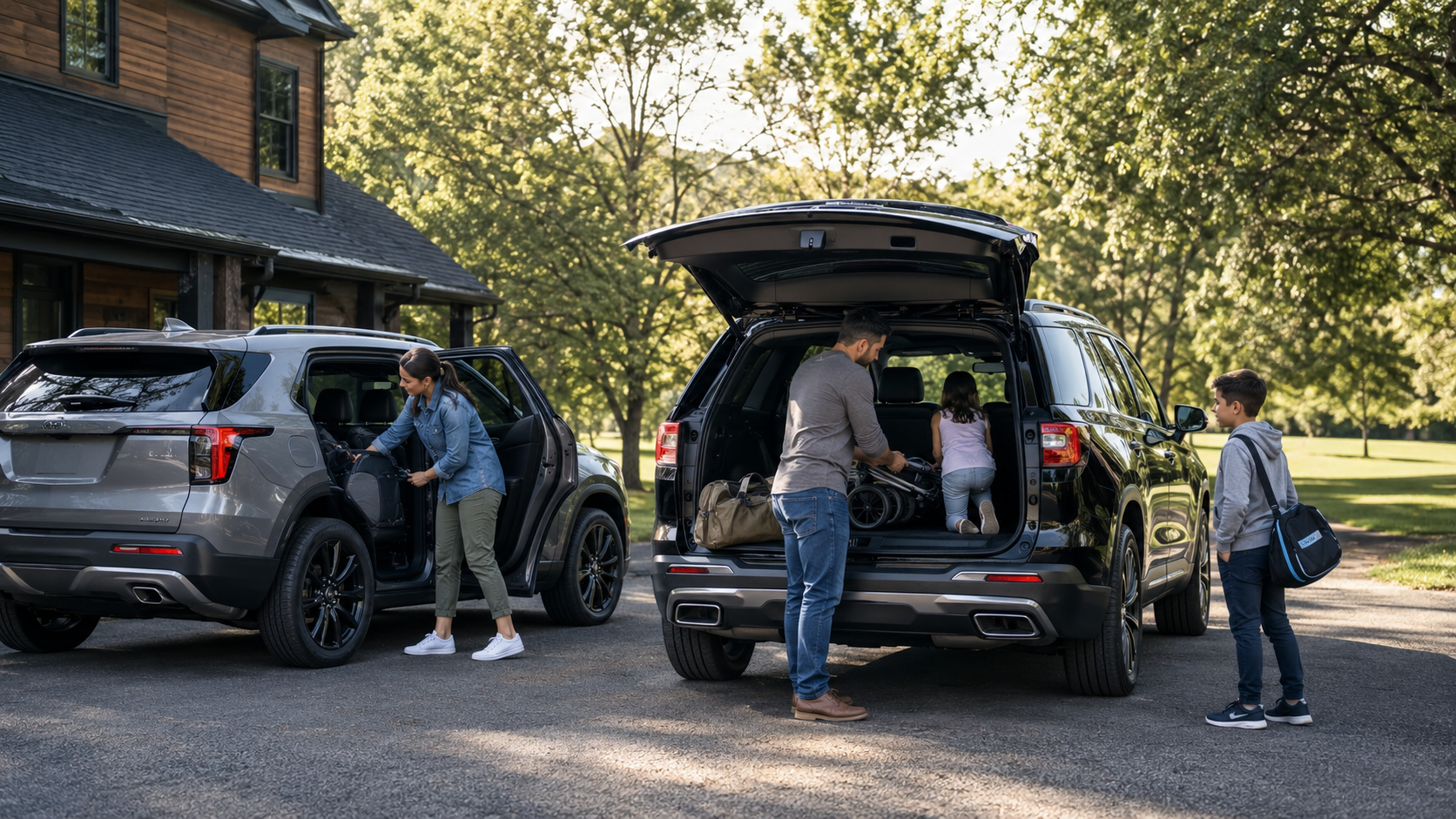
GMC Terrain vs Chevy Traverse is a comparison when your family is deciding how much SUV space it truly needs. One model keeps the footprint smaller and seats five. The other adds a third row and much more maximum cargo room. Therefore, the choice starts with passenger count, cargo habits, parking space, and budget. Each difference connects directly to how the cabin is packaged and how much vehicle surrounds it. How Much SUV Space Does Your Family Need? The GMC Terrain is a small SUV with two rows and seating for five. The 2026 model measures 181 inches from bumper to bumper. By contrast, the 2026 Chevrolet Traverse stretches about 204.5 inches and uses three rows. That makes the Traverse roughly 23.5 inches longer before trim specific changes enter the measurement. That extra length gives Chevrolet more room to package another passenger row and a much larger cargo area. However, added length also changes how much garage depth and parking room the SUV needs. A shorter body can feel easier to place in tighter lots or crowded driveways. Therefore, families should measure the spaces they use most before focusing on cabin numbers alone. Can five seats cover school runs, work commutes, errands, and weekend plans? That answer defines the first major split between these SUVs. If five seats cover nearly every trip, Terrain keeps the layout simple. If six or more people ride together every week, Traverse offers seating that better matches that routine. When Does a Third Row Make Sense? A third row gives the Traverse room for passengers beyond the second seating row. Chevrolet lists seating for up to eight on LT with the available second row bench. Z71, RS, and High Country seat seven. By contrast, Terrain provides two rows with space for up to five people. The important question is how frequently those extra seats will carry someone. A third row earns its space when carpools, relatives, or larger households fill it on a regular schedule. Still, an empty third row occupies cabin length that a smaller household may never need. For this reason, seat count should reflect routine trips instead of rare holiday gatherings. Second row layout also changes access. Traverse models with seven seats use second row captain's chairs, leaving a path between them. An eight seat LT uses a bench that adds one seating position across that row. Therefore, families using child seats should consider how passengers will reach row three. Access can matter as much as the published seat count. Terrain avoids that third row decision entirely. Its two row cabin keeps every passenger within the first and second rows. In addition, folding the rear seat opens more room when passenger demand drops. Cargo Space With Passengers Still Seated Cargo measurements only make sense when you know which seats remain upright. The Traverse provides 22.9 cubic feet behind its third row. Fold row three, and space grows to 56.6 cubic feet behind the second row. With both rear rows folded, Chevrolet lists 98 cubic feet of maximum cargo volume. Terrain uses a simpler two row layout. Cargo sits directly behind its second row because there is no third row. Therefore, a family comparing luggage room should match the measurement to the number of occupied rows. Maximum cargo figures do not show how much room remains with every needed passenger seated. Consider a weekend trip with six people. Traverse can keep row three available and still provide 22.9 cubic feet behind it. A five person household can fold that row and gain much more room. By contrast, Terrain works best when five seats cover the passenger plan and cargo fits behind row two. This distinction matters for strollers, sports gear, grocery hauls, and travel bags. Furthermore, cargo shape deserves attention during an in person walkaround. A wide opening, floor height, seat folding pattern, and available storage pockets can change how easily bulky items fit. Price Fuel and Power Across Two SUV Sizes The 2026 Terrain starts at $30,200 before destination charges and options. GMC equips it with a 1.5 liter turbocharged four cylinder engine producing 175 horsepower. Front wheel drive models pair that engine with a continuously variable transmission. GMC lists an EPA estimate of 26 city and 28 highway mpg for that configuration. The 2026 Traverse starts at $40,800 before destination charges and options. Chevrolet equips it with a 2.5 liter turbocharged engine producing 328 horsepower and 326 pound feet of torque. An eight speed automatic transmission comes standard. Chevrolet lists 20 city and 26 highway mpg for front wheel drive. Those numbers show what the larger platform asks from the budget. Traverse costs more at the starting point and carries a larger body. However, that spending also supports another row, more maximum cargo room, and far greater engine output. Terrain asks less at the starting point and uses less fuel in its front wheel drive form. Therefore, a family that rarely needs six seats may prefer the smaller footprint. A household filling three rows can view the higher Traverse cost as payment for space it will use. Choosing the Better Fit for Gonzales Family Life GMC Terrain vs Chevy Traverse becomes easier to sort when you begin with your household schedule. First, count how many people ride together during a normal week. Next, consider what must travel with them. Then, compare those needs with your garage, parking spaces, and monthly driving distance. The Terrain suits families that can stay within five seats and want a shorter SUV. In addition, its lower starting price and stronger front wheel drive fuel estimates can support commuting and errands. Traverse serves households that need a third row or much more cargo room after folding seats. Before choosing either SUV, sit in every row your household expects to use. Bring a child seat if one will ride in the vehicle. Furthermore, open the liftgate and study the cargo floor with required seats upright. That simple check shows whether published volume matches the objects you carry. Both SUVs solve different space problems. Terrain keeps the package smaller and simpler. Traverse expands passenger and cargo choices through a longer three row layout. Therefore, the stronger fit is the one that matches your weekly passenger count, storage needs, parking space, and budget.

How Long Can You Drive on a Spare Tire in Louisiana

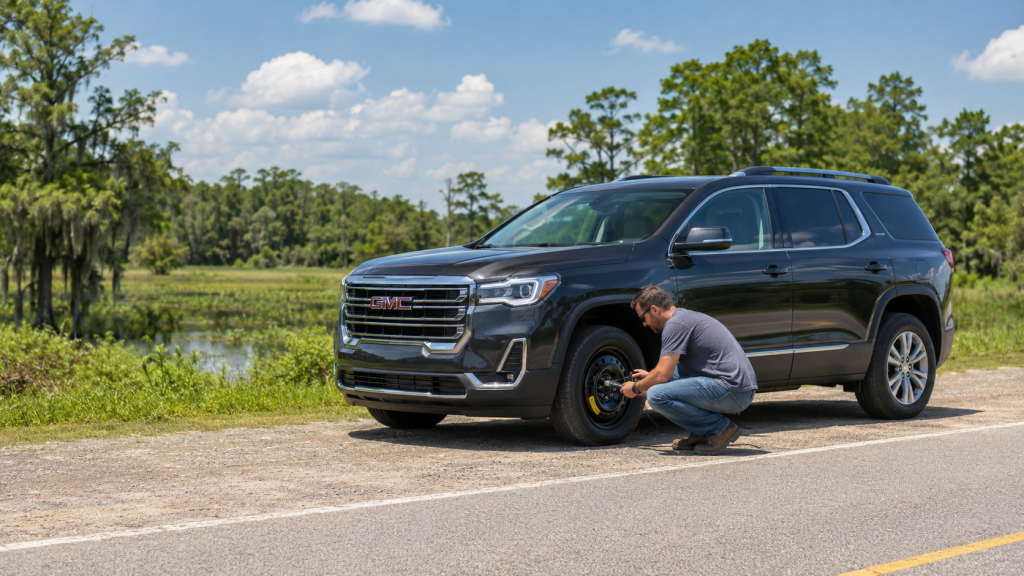
How long can you drive on a spare tire after a flat in Louisiana? The exact limit comes from the spare sidewall and your vehicle owner’s manual. Many compact spares list a speed limit near 50 mph. However, the permitted distance can vary by tire and vehicle. A spare restores short term mobility after tire damage. It does not replace a permanent tire repair. Therefore, travel only far enough to reach a safe inspection location. How Spare Type Changes the Answer Spare tire type controls how the vehicle should be driven after a flat. Compact temporary spares and full size spares serve different roles. A compact spare has a smaller wheel and narrower tread than the normal road tires. It may also carry a much higher inflation requirement. Therefore, its sidewall must receive close review before travel. A full size spare may match the other four tires. However, its age, pressure, tread depth, and load rating still need inspection. A spare stored for years can lose air without visible damage. Check these details before moving: more Read the maximum speed printed on the spare sidewall. Find the spare tire instructions inside the owner’s manual. Measure pressure with a tire gauge before entering traffic. Confirm that the tire has no cracks, bulges, cuts, or exposed material. Check whether cargo or trailer limits apply during spare tire travel. Some vehicles carry a full size wheel with a different tire or tread pattern. Therefore, matching wheel size alone does not prove unrestricted travel. Follow the manual until a tire professional reviews the setup. Why Compact Spares Have Strict Limits Why does a compact spare change how the vehicle moves? Its smaller dimensions alter grip, braking response, and wheel rotation. A narrower tread places less rubber against the road. Therefore, traction may feel different during braking or cornering. Wet pavement can make that difference easier to notice. The spare may also rotate at a different rate than the other tires. That difference can place added strain on driveline parts. For this reason, the manual may limit speed, distance, or axle placement. High speed creates more tire flex and heat. Additionally, hard braking transfers force quickly through the smaller tire. Sharp turns can also place greater load across its narrow contact area. Drive smoothly and leave more stopping room. Avoid sudden steering, rapid acceleration, and rough pavement when possible. Still, do not remain on an unsafe shoulder longer than necessary. A compact spare should support a direct trip to tire service. It should not support errands, commuting, or delayed repair plans. How Louisiana Heat Changes Tire Stress Louisiana summer heat raises pavement and tire temperatures during travel. However, heat does not create one universal distance reduction for every spare. Correct inflation becomes more important during hot travel. An underinflated tire flexes more with each rotation. Consequently, added flex creates internal heat and places more stress on the tire. Check spare pressure before a trip whenever possible. The best reading comes while the tire is cold. That means the vehicle has remained parked for several hours. Do not release air from a warm tire simply because the reading looks high. Heat can raise pressure after driving. Releasing warm air may leave the tire too low after cooling. A compact spare may require far more pressure than the normal road tires. Therefore, never copy the regular tire pressure without checking the spare label. Sunlight and trunk heat can also age stored rubber. Cracks, hard rubber, or sidewall damage require professional review. Visible tread alone does not prove that an old spare remains ready. Highway Travel Loads and Towing Need Extra Care Can you drive on the interstate with a compact spare? The answer rests on the spare speed limit and the safest route to service. Traffic may move faster than the spare permits. Therefore, a nearby surface route may offer a safer path. Choose a route that keeps speed within the printed limit. Heavy cargo adds more weight across the tires. Passengers, tools, luggage, and recreational gear can raise tire strain. Consequently, a loaded GMC truck or SUV may need a different roadside plan. Trailer travel requires even greater caution. A trailer adds tongue weight and changes steering, braking, and stability. The owner’s manual may restrict towing while a temporary spare is installed. Do not assume the restored tire shape means full towing support has returned. Instead, stop in a safe location and review the manual. Roadside assistance may provide the safer route when towing limits remain unclear. Tire pressure monitoring may not read the spare. Therefore, the absence of a warning light does not prove correct pressure. A manual gauge remains necessary. Warning Signs That Mean Stop Driving A spare may develop trouble before reaching its printed distance. Therefore, pay attention to new movement, sound, and steering changes. Stop in a safe location when you notice: Strong vibration through the steering wheel, seat, or floor. Pulling that makes the vehicle difficult to keep straight. Repeated thumping, scraping, rubbing, or flapping sounds. Rapid pressure loss or a tire pressure warning. A visible bulge, crack, cut, or damaged sidewall. Smoke, burning odor, or unusual heat near the wheel. Do not continue solely because the service location is close. A damaged spare can fail without much warning. Therefore, move away from traffic and request roadside help. Also stop when the tire contacts bodywork or brake parts. Incorrect installation or wheel fit can create immediate damage. Loose wheel fasteners can also cause vibration and wheel movement. After installation, recheck that the wheel sits flat against the mounting surface. Follow the tightening steps listed for the vehicle. A service professional should verify the installation soon afterward. When Permanent Tire Service Should Happen Permanent tire service should happen at the nearest reasonable opportunity. A compact spare exists for emergency travel only. A tire professional must inspect the damaged road tire before approving repair. Puncture location, puncture size, internal damage, tread depth, and prior repairs all enter that decision. Sidewall damage usually requires replacement because that area flexes during travel. Driving without enough air can also damage the inside of the tire. Therefore, a small visible puncture may hide larger internal harm. Bring these details to the service visit: Where the pressure loss first appeared. How far the vehicle traveled after the warning. Whether the tire became fully flat. Whether sealant entered the damaged tire. Whether the spare produced noise, vibration, or steering changes. Ross Downing GMC Gonzales can inspect the damaged tire, check the spare, and review replacement options. The service team can also confirm inflation requirements for the exact GMC. A spare tire should shorten the roadside emergency, not extend it. Follow the printed limits, reduce speed, and avoid added load. Then arrange permanent tire service before normal travel resumes.

Vehicle Inspection Report Dealership Guide in Gonzales

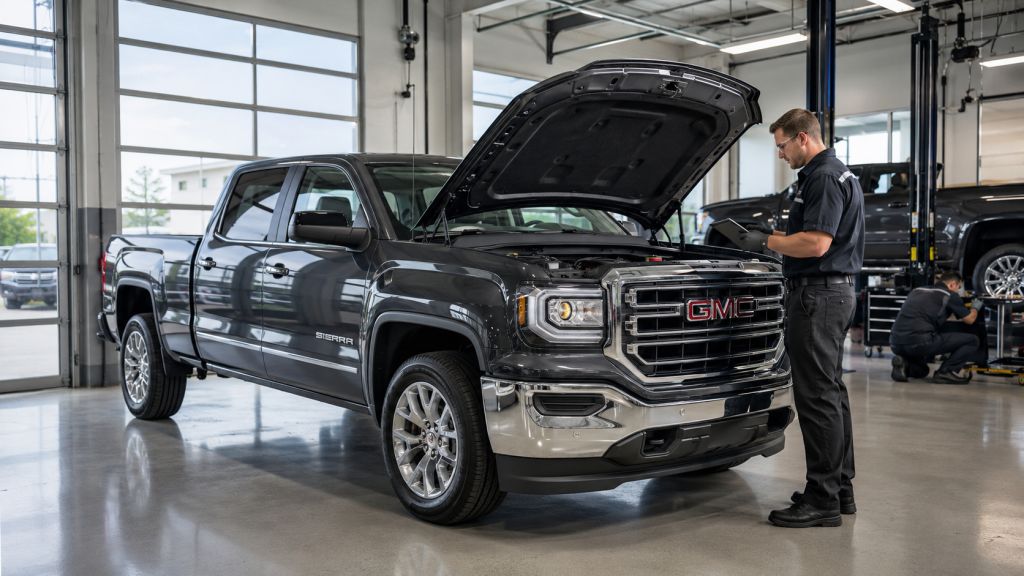
A vehicle inspection report dealership guide should explain what was checked, measured, found, and recommended before purchase. A useful report records present wear, visible defects, diagnostic findings, and repair needs. It should also identify the exact vehicle through its identification number. No inspection can promise a repair free future. However, a detailed report gives Gonzales shoppers stronger information before signing. It also creates a written record for pricing, service, and warranty discussions. What a Vehicle Inspection Report Should Explain What should a vehicle inspection report show before you purchase a used vehicle? A useful report records measured wear, visible defects, diagnostic findings, and recommended repairs. The report should name the technician or shop that completed the work. It should also show the inspection date and current mileage. In addition, the vehicle identification number should match the unit under review. A useful report should include: more Tire tread depth and tire age should appear for all four positions. Brake pad measurements and rotor findings should appear in writing. Fluid levels, leaks, battery test results, and warning lights should be recorded. Diagnostic codes and road test findings should include clear notes. Repair needs should be grouped by urgency and estimated timing. A simple checkmark gives little context. By contrast, measurements show how much material remains and which items may need service soon. Why History Records Do Not Replace Inspection A vehicle history report reviews recorded events from the past. It may show title records, reported collisions, mileage entries, prior owners, and some service work. However, not every repair enters a reporting database. Private work, small body repairs, and unreported damage may never appear. Therefore, a clean history report cannot prove clean current condition. A physical inspection answers a different question. It reviews what the vehicle shows today. Paint differences, panel gaps, leaks, tire wear, and warning codes can reveal concerns outside the history file. Service records add another layer. They may confirm oil changes, brake work, fluid service, or major repairs. Still, missing records do not prove that care never occurred. For this reason, shoppers should review the history file, service records, and physical report together. Each source fills a different information gap. What Tires Brakes and Suspension Can Reveal Tires can reveal more than remaining tread. The report should record tread depth, tire age, sidewall damage, matching type, and wear shape. Uneven wear can point toward low pressure, missed rotations, worn steering parts, suspension wear, or wheel geometry concerns. Therefore, the report should explain the pattern and any next step. Brake review should include pad thickness, rotor surface, brake fluid, pedal feel, and warning lights. A vehicle may stop normally while still nearing brake service. Steering and suspension parts also deserve close review. Worn joints, bushings, shocks, or struts can create noise, looseness, or poor tire wear. During the road test, the vehicle should track straight and brake smoothly. Vibration, pulling, clunks, or repeated noise should appear in the written findings. These measurements create a clearer repair picture. They also make price discussions more specific. What Fluids and Underhood Checks Should Cover Fluid review should include levels, visible condition, odor, and leak location. Engine oil, coolant, brake fluid, and accessible driveline fluids deserve attention. Dark fluid alone does not prove internal damage. Therefore, the technician should compare visual findings with service records, mileage, and manufacturer intervals. Leaks need clear notes. The report should identify the fluid type, source area, severity, and need for further testing. A damp area and an active drip require different responses. Battery testing should include measured condition and starting strength. Belts, hoses, filters, terminals, and cooling parts should also receive review. The underbody can reveal fluid loss, impact damage, corrosion, or loose shields. In addition, the exhaust should receive a visual check for damage or leaks. A written report should separate maintenance needs from diagnostic concerns. That distinction keeps routine service from sounding like confirmed mechanical failure. Why the Scan and Road Test Both Matter A diagnostic scan reads active, pending, and stored fault codes. It can add useful electronic information even when no warning light appears. Still, a scan cannot measure tire age, brake thickness, fluid leaks, or body repairs. It also cannot confirm how the vehicle feels while moving. The road test should include changing speeds, turns, bumps, and controlled braking. Those inputs test steering, shifting, braking, suspension movement, and noise. The driver should note delayed shifts, vibration, pulling, steering play, brake pulsation, or unusual sounds. Climate controls, cameras, windows, locks, and interior electronics should also receive testing. One short loop on a smooth road may miss concerns. Therefore, the route should include several surfaces and speeds when safe. Electronic data and road feedback should support each other. When either source raises concern, further diagnosis may be needed before purchase. Which Documents Should Be Reviewed Before Signing The inspection report is one part of the final review. Gonzales shoppers should also read the history file and federal window notice. Service records, recall information, and warranty terms deserve review too. Before signing, confirm these items: The federal window notice should state whether warranty coverage applies or the vehicle is sold as is. Written warranty terms should identify covered parts, limits, dates, and required steps. Any promised repair should appear in the purchase paperwork. Open recall information should match the exact vehicle identification number. The inspection report should list findings, measurements, and repair priorities. An inspection does not create warranty coverage. A warranty defines which repairs may receive coverage under its written terms. Spoken repair promises can become difficult to prove later. Therefore, every promised repair should appear in writing before delivery. Ross Downing GMC Gonzales can review inspection records, warranty details, and service history for available used vehicles. Shoppers should ask questions before signing and keep copies of every document. A thorough review cannot predict every future repair. However, it can show current wear, known concerns, and near term service needs. That information supports a more informed used vehicle decision.

GMC Acadia vs Yukon for Growing Gonzales Families

The GMC Acadia vs Yukon decision starts with how often your family fills the third row and cargo area. Acadia uses a midsize three row layout. Yukon uses a larger full size structure. Both can seat up to eight people. However, those seats do not provide the same space or travel role. A clear choice starts with who rides in each row. It also starts with what must fit behind them. Trailer plans, garage size, and daily parking should enter the review as well. Why Seating Capacity Does Not Settle the Choice Both GMC SUVs can offer seating for up to eight. Still, equal seat counts do not create equal cabin space. Acadia gives families three rows in a smaller body. Yukon adds more room for people, gear, and mechanical hardware. The question is not only how many people fit. Instead, ask who will sit in the third row. Young children may need less legroom than adults. Older children may also need easier entry during school or sports travel. more Seat width matters when several child seats stay installed. Door openings and second row movement matter too. Therefore, families should test their own seats before making a choice. Acadia may cover a household that uses row three several times each week. Yukon may suit homes with frequent adult riders or larger teens. Even so, passenger count alone should not control the purchase. How Third Row Use Changes the Decision The third row should be judged by time, access, and passenger size. A short ride across Gonzales creates one need. A long interstate trip creates another. Acadia can provide flexible seating without full size exterior dimensions. That can work well for children, friends, or occasional guests. However, frequent adult use may point toward Yukon. Families should test several details during the visit: Install each child seat in its likely position. Then check access to row three. Move the second row forward. Confirm that passengers can enter without strain. Sit in every occupied row for several minutes. Check knee, foot, and head room. Confirm that climate vents and charging ports reach each regular passenger. Furthermore, seat placement can change daily routines. A child seat may block the easiest path into row three. Folded second row sections may also reduce seating choices. For this reason, the strongest choice comes from a full cabin test. Bring the people who ride most. Then repeat the entry process several times. Cargo Behind Passengers Creates a Clear Divide Maximum cargo numbers require folded seats. Therefore, they do not describe a family trip with every needed row raised. Current Acadia data lists 23 cubic feet behind row three. Current Yukon data lists 25.5 cubic feet in the same area. That difference may sound small. Yet the shape of the floor and side walls can change what fits. A stroller, cooler, sports bag, and grocery load can fill the space quickly. Large suitcases can also block rear visibility. Therefore, families should test their own gear before relying on one published number. Acadia reaches 97.5 cubic feet with rear rows folded. Yukon reaches 122.8 cubic feet. Those figures matter when fewer passengers travel. They matter less when all three rows stay occupied. Yukon XL may enter the review when full passenger loads also bring heavy luggage. Its longer rear body adds more space behind row three. Still, that extra length asks for more garage depth and parking room. When Towing Pushes a Family Toward Yukon Acadia can tow up to 5,000 pounds when properly equipped. Yukon can reach up to 8,400 pounds with the proper configuration. Those ceilings create a strong dividing point. However, the trailer label is only the starting number. Loaded trailer weight must include water, food, gear, fuel, and installed equipment. Tongue weight also presses down on the SUV. Passengers, cargo, accessories, and tongue weight share the payload limit. Therefore, a full family cabin can reduce the remaining trailer allowance. Acadia may fit smaller campers, utility trailers, or light recreational loads. Yukon may fit heavier campers, boats, or frequent trailer travel. The exact answer still comes from the chosen engine, drivetrain, hitch equipment, and payload label. Yukon also offers V8 and diesel engine choices. Acadia uses a 2.5L turbo engine. As a result, Yukon gives families more powertrain paths for heavier work. Before towing, compare the exact SUV with the loaded trailer. Do not rely on the largest published number alone. When Acadia Is Easier to Live With More room is not always the smarter daily choice. Acadia gives families three rows in a smaller exterior package. Therefore, it may fit school lines, shopping lots, and home garages with less effort. A smaller body can also make routine errands simpler. Tight turns, narrow spaces, and crowded parking areas may require fewer corrections. In addition, Acadia can carry three rows without the full size footprint of Yukon. Families should measure the garage before visiting. Include shelving, steps, stored items, and liftgate clearance. Also consider the space needed to open rear doors beside another car. Acadia may cover most family needs when row three carries children or occasional guests. It may also cover moderate trailer plans within the exact rating. Yukon earns its larger footprint when the family uses that room each week. Otherwise, Acadia may provide enough seats and cargo space for normal weeks. Which Family Routines Justify Yukon Yukon makes the strongest case when several demanding needs occur every week. Frequent adult third row use is one sign. Heavy trailer plans are another. Before choosing, review these repeated routines: Adults or larger teens use the third row during long trips. The family carries many passengers and bulky gear at the same time. A camper, boat, or trailer approaches Acadia limits after loading. V8 or diesel engine choice matters for regular trailer travel. The home garage and normal parking areas can handle Yukon dimensions. Acadia remains a strong fit when three rows matter but full size space does not. It can serve school travel, family errands, and lighter towing within the exact rating. Ross Downing GMC Gonzales can place both SUVs side by side for a clearer review. Bring child seats, travel gear, and trailer details to that visit. Therefore, the comparison reflects your normal family routine. The right answer becomes clearer when space, cargo, towing, and parking are reviewed together. Acadia covers many growing families well. Yukon fits families whose repeated loads require more room and stronger trailer support.

What Is MSRP for GMC Shoppers in Gonzales Louisiana

What is MSRP when buying a new GMC in Gonzales, Louisiana? MSRP means Manufacturer’s Suggested Retail Price, which is the vehicle price recommended by GMC. The number gives shoppers a starting point for comparing models, trims, and factory equipment. However, it is not the same as the final amount due at purchase. A new GMC can show several prices during the shopping process. Each number serves a separate purpose. Therefore, clear comparisons require more than one figure. What MSRP Means on a New GMC MSRP begins with the manufacturer, not the dealership. GMC assigns a suggested retail price to each model, trim, and factory configuration. The word suggested matters because the dealership can set the selling price. MSRP appears on the new vehicle window label. That label identifies the exact truck or SUV and lists its factory equipment. In addition, it shows the price attached to each factory option or package. more What does MSRP stand for in a dealership conversation? It stands for Manufacturer’s Suggested Retail Price. Therefore, it gives everyone the same starting reference for that exact vehicle. Still, MSRP does not settle the full transaction. Dealer pricing, incentives, trade credit, taxes, registration, and financing enter later. For this reason, shoppers should treat MSRP as the first number in a longer pricing review. What Appears on the Window Sticker A base MSRP usually reflects the starting price for a specific model and trim. However, the exact vehicle may include added factory equipment. Those choices raise the total shown on its window label. A GMC Sierra may include a different engine, drivetrain, wheel package, or trailering package. A GMC Yukon may include different seating, technology, or appearance packages. Therefore, two vehicles with the same trim name can show different sticker totals. The window label can include these pricing lines: The base price for the model and trim starts the calculation. Factory options and packages add their listed amounts. The destination charge covers delivery from the manufacturer. The total vehicle price combines the listed factory pricing lines. Destination deserves close review because websites can display pricing in different ways. One page may lead with base MSRP. Another may show a total that already includes destination. Therefore, compare the same line on both vehicles. Dealer installed accessories may appear outside the factory window label. Ask whether the vehicle includes tint, steps, protection products, or other added items. Then request the price for each item in writing. Why Dealer Pricing Can Differ From MSRP Can a dealership sell a GMC below MSRP? Yes. Dealer discounts or manufacturer incentives may lower the advertised selling price. Inventory levels, model demand, and promotional periods can also shape the listed amount. A vehicle can also appear above MSRP. A market adjustment or dealer installed item may raise the price. Therefore, ask what created the difference before comparing offers. Several prices may appear beside one GMC listing. The page may show MSRP, a dealer discount, an incentive amount, and a final advertised price. Each line needs its own explanation. In addition, some incentives require specific qualifications. A program may apply only to current owners, military members, recent graduates, or certain financing choices. Eligibility rules and expiration dates can change the amount available. The strongest comparison uses the same equipment and the same qualification rules. Otherwise, one offer may appear lower because it includes an incentive unavailable to another shopper. How Incentives and Trade Credit Enter the Deal Does a rebate change the original MSRP? No. The manufacturer’s sticker remains the same. Instead, the rebate lowers the transaction amount for an eligible shopper. Dealer discounts work differently from manufacturer incentives. The dealership provides one reduction, while the manufacturer supports the other. Therefore, the purchase worksheet should identify each amount separately. Trade credit belongs on its own line as well. The dealership assigns a figure to the current vehicle. That credit reduces the remaining balance, but it does not change the new GMC’s MSRP. Keeping these figures separate makes the offer easier to review. First, confirm the selling price before trade credit. Next, review the trade amount. Then examine taxes, fees, and financing. A shopper with negative trade equity may carry an unpaid balance into the new loan. By contrast, positive equity may reduce the amount financed. Therefore, the trade can change the loan without changing the new vehicle’s sticker. Why Monthly Payment Is Not the Final Price A monthly payment does not show the complete cost of a GMC. The payment comes from the amount financed, interest rate, loan term, and payment schedule. Down payment and trade equity also change the financed balance. A longer loan term can reduce the monthly amount. However, it can also increase total interest paid. Therefore, compare the annual percentage rate, term length, amount financed, and total of payments. Optional products can also enter the loan. These may include service contracts, protection plans, or other selected items. Ask whether each product is optional and review its separate price. Why can a higher priced GMC show a lower monthly payment? It may carry a lower rate, larger down payment, longer term, or stronger incentive. Therefore, payment alone cannot identify the lower cost offer. Before signing, review every figure on the finance contract. Confirm the selling price, trade credit, cash down, amount financed, annual percentage rate, term, and total payments. Which Number Gonzales Shoppers Should Compare The out the door price gives Gonzales shoppers the clearest total for comparing offers. It includes the agreed selling price plus taxes, registration, and listed dealership charges. It also reflects approved discounts and incentives. Request the total in writing for the exact GMC under review. Then confirm that each quote uses the same equipment, incentive qualifications, and trade assumptions. A complete comparison should show: The exact vehicle identification number connects the quote to one GMC. The MSRP and selling price appear as separate figures. Each discount and incentive appears on its own line. Taxes, registration, documentation, and added items appear clearly. Trade credit and financing terms remain separate from the vehicle price. Ross Downing GMC Gonzales can answer local pricing and financing questions for shoppers near Gonzales, Baton Rouge, and Prairieville. Bring the written quote, window label, and trade details into the conversation. MSRP gives shoppers a useful starting point, but it is only one part of the purchase. Therefore, compare the sticker, selling price, credits, fees, and financing separately. That process creates a clearer view of the final GMC cost.

GMC Terrain vs Acadia: Which SUV Fits Your Household?

The GMC Terrain vs Acadia decision comes down to one structural question: how many passengers does your household carry regularly? Both are GMC crossovers. Both share a family-oriented feature set and the same dealer network. However, the Terrain is a compact two-row SUV and the Acadia is a midsize three-row SUV. That structural difference shapes every other comparison point between them. Two Different Vehicle Categories The Terrain and the Acadia are not the same vehicle at different sizes. Instead, they occupy different segments with different design priorities. The Terrain is built around two rows, a compact footprint, and fuel efficiency. The Acadia, by contrast, is built around three rows, a larger cargo floor, and the ability to move more passengers with more gear. more A buyer comparing the two on price alone misses the more important comparison. The Terrain starts at approximately $32,995. The Acadia starts at approximately $42,995. That $10,000 gap reflects a difference in vehicle category, not trim content. As a result, choosing between them based on budget without accounting for seating need creates a mismatch that no feature list resolves. Seating and Passenger Capacity The Terrain seats five passengers across two rows. The second row accommodates three passengers with adequate shoulder room for adults on shorter trips. For households that carry no more than five people, the Terrain covers every daily use case without the added length of a third row. The Acadia seats seven passengers in its standard second-row bench configuration. That bench allows eight passengers, but third-row occupants must climb over a folded seat on trims without captain's chairs. The third row suits passengers under 5'8" on extended trips. Adult passengers in the third row will find legroom limiting after the first hour. For households with three or more children, or for buyers who transport more than five people regularly, the Acadia's third row changes the vehicle's function entirely. Cargo Space The Terrain delivers 29.6 cubic feet of cargo space behind the second row. With the second row folded, that number rises to 63.3 cubic feet. The Acadia delivers 15.6 cubic feet behind the third row, 41.7 cubic feet with the third row folded, and 79.2 cubic feet with both rows folded. The Terrain's cargo number behind the second row is larger than the Acadia's number behind the third row. That gap matters for buyers who load the vehicle with all seats occupied. When the Acadia carries all seven passengers, it provides less usable rear cargo space than a fully loaded Terrain. The Acadia's total cargo advantage only applies when the third row is folded. So for households that use all three rows regularly, the Terrain is the stronger daily cargo vehicle when all seats are in use. Safety Tech Differences in the Denali Trims Both the Terrain Denali and the Acadia Denali include GMC's standard advanced driver assistance suite. That shared foundation covers automatic emergency braking, forward collision alert, lane keep assist, lane departure warning, blind zone steering assist, and rear cross-traffic braking. However, the safety tech differences between the two Denali trims go beyond that baseline. The Acadia Denali adds intersection automatic emergency braking. That system detects cross-traffic threats at intersections where traditional forward collision sensors have limited angles. It also includes a safety alert seat that delivers haptic pulse warnings through the driver's seat cushion. That addition means the driver receives alerts even when audio or visual warnings go unnoticed. Enhanced pedestrian detection and lane keep assist on curves are also part of the Acadia Denali's broader suite. The Terrain Denali includes HD surround vision, Smart Frequency dampers, and standard AWD. It also covers the full base driver assistance suite in a more compact package. For buyers who want the most comprehensive active safety coverage in either model, the Acadia Denali carries the wider suite. That difference reflects its role as a midsize SUV operating at full occupancy in higher-exposure environments. Which Model Is Better for Towing The Terrain tows up to 1,500 pounds across every trim. That rating covers small utility loads. It does not support boats, camper trailers, or travel trailers of substantial size. The Acadia, on the other hand, tows up to 5,000 pounds across every trim with the trailering package confirmed across all configurations. That 3,500-pound difference defines the towing conversation entirely. A buyer who needs to tow a personal watercraft, a small camper, or a utility trailer above 1,500 pounds has one option in this comparison. The Acadia's 2.5L turbo handles heavier structures and maintains highway passing power under load. The Terrain does not offer a towing upgrade path that closes that gap. Therefore, for towing, the Acadia is the only applicable choice between the two. Which Model Is Better for Long Road Trips For long road trips with more than five passengers, the Acadia is the stronger choice. The larger infotainment screen, additional powertrain reserve under highway load, and extra row all contribute to a less fatiguing long-distance drive. Families with children in a third row also benefit from the physical separation that the additional row creates on multi-hour trips. The Terrain, however, is the stronger road trip vehicle for households of four or fewer. Its fuel efficiency advantage — up to 27 MPG highway versus the Acadia's 25 MPG highway — extends the range between fuel stops. The shorter wheelbase also makes city navigation and parking at destinations more manageable. For a two-adult, two-child household covering 400 miles, the Terrain handles the trip without giving up anything the Acadia provides for that passenger count.

GMC Yukon AT4 vs Denali: Which Trim Is Right for You?

The GMC Yukon AT4 vs Denali decision starts with a single question: what do you use your Yukon for most? Both trims sit at the top of the Yukon lineup. Both carry the same full-size platform, the same three-row cabin, and the same core technology suite. The divergence is in how each trim is engineered to perform — one for terrain, one for road composure and interior refinement. Two Different Design Philosophies The AT4 and the Denali share a body. They do not share a suspension calibration, a tire specification, a drivetrain default, or an interior priority. GMC engineers those two trims from different starting points. The AT4 begins with a terrain-capable foundation and layers interior content on top. The Denali begins with road composure and interior refinement and layers available off-road capability underneath. more That difference shows up on the highway before it ever shows up on a trail. The AT4's suspension is calibrated for terrain response — firmer damping that absorbs trail impacts but transmits more road texture to the cabin at highway speed. The Denali uses Magnetic Ride Control, a system that adjusts damper firmness thousands of times per second based on road conditions. On smooth pavement, the Denali is noticeably more composed. On broken pavement or gravel, the AT4 absorbs irregularities more predictably. Neither trim is unusable in the other's environment. Each one is optimized for a specific priority. Powertrain: Where They Diverge First The AT4 comes standard with the 5.3L V8, producing 355 horsepower and 383 lb-ft of torque. The Denali comes standard with the 6.2L V8, producing 420 horsepower and 460 lb-ft of torque. That 65-horsepower gap is the first mechanical difference between the two trims and the one with the most direct effect on daily driving. At highway speeds, the 6.2L pulls more confidently under load. When the Denali merges onto a highway towing a trailer near its rated capacity, the larger engine maintains momentum without the transmission hunting for a lower gear. The 5.3L in the AT4 is a capable engine. It handles the same towing loads when properly configured. At full trailer weight, it works harder to maintain speed on grades and requires more throttle input in passing situations. Both trims offer the 3.0L turbo diesel I-6 as an alternative for buyers who prioritize range and fuel efficiency over peak output. AT4 Off-Road Hardware Explained The AT4's off-road advantage comes from four hardware components that the Denali does not include: skid plates, all-terrain tires, Active Response 4WD as the standard drivetrain, and optional air ride adaptive suspension. The skid plate package protects three specific underbody areas — the transfer case, the front differential, and the fuel tank. Those are the components most exposed during low-clearance trail travel, creek crossings, and rock contact. On pavement, skid plates add weight without benefit. On technical terrain, they are the difference between a recoverable situation and component damage. The AT4 rides on all-terrain tires from the factory. That specification gives the tire a more aggressive sidewall and tread pattern than the highway-oriented tires on the Denali. The grip difference on loose gravel, wet grass, or dirt roads is measurable without any additional hardware. Active Response 4WD is standard on the AT4, meaning 4WD engagement is the default configuration rather than an add-on. The available air ride adaptive suspension raises ground clearance by up to two inches over the AT4's already elevated stance. For buyers who travel unpaved roads regularly or take the vehicle into light technical terrain, that additional clearance changes the approach and departure angles in ways that matter. For buyers who rarely leave pavement, the base AT4 suspension handles the load without the air system. Denali Interior and Technology The Denali delivers two things the AT4 does not come standard with: the 6.2L V8 and Magnetic Ride Control. Beyond those two mechanical advantages, the Denali separates from the AT4 through interior specification. The Denali comes standard with open-pore Paldao wood trim, genuine leather seating surfaces, a 16.8-inch diagonal infotainment screen, and a 15-inch head-up display. The AT4 includes a 16.8-inch screen as well, but uses different interior materials oriented toward durability rather than refinement. The Denali's cabin is quieter at highway speed, partly because of the Magnetic Ride Control's effect on body motion and partly because of additional sound insulation in the door panels and headliner. Super Cruise hands-free driver assistance is available on the standard Denali as an option. It is not included in the base Denali price. On the Denali Ultimate, Super Cruise is standard equipment. On the AT4, Super Cruise is available as an option at the AT4 Ultimate level. Buyers comparing standard trim pricing should not assume Super Cruise is included in either case. The Denali Ultimate Upgrade Path The Denali Ultimate takes the standard Denali further in three specific directions. Air suspension becomes standard at the Denali Ultimate level, replacing the Magnetic Ride Control setup and giving the driver adjustable ride height at the press of a button. Wheel size increases to 24 inches. The interior adds massaging front seats, an 18-speaker Bose Performance Series audio system, and dual 12.6-inch rear seat entertainment displays. Super Cruise moves from available to standard. For buyers who want the most complete version of the Denali, the Ultimate package represents a single upgrade decision rather than a list of individual options to select. Towing: Which Trim Fits the Job Both the AT4 and the Denali reach a maximum towing capacity of 8,200 pounds when equipped with the Max Trailering package. That package is not included in the base price of either trim. It adds an integrated trailer brake controller, a hitch guidance camera system, a trailering app with sway control, and the necessary cooling upgrades to sustain towing at high load. Without the Max Trailering package, the towing ceiling on both trims is lower. Buyers who plan to tow consistently should confirm Max Trailering is on the build sheet before comparing total prices. The Denali has a towing confidence advantage that does not appear on the spec sheet. The standard 6.2L V8 provides more reserve torque at highway towing speeds than the AT4's standard 5.3L. Towing at 7,000 pounds on a flat highway, both trims handle the load. Towing that same weight up a long grade in summer heat, the 6.2L maintains speed more naturally while the 5.3L runs closer to its threshold. For buyers who tow heavy loads regularly on varied terrain, that reserve matters over the course of a long haul. Which Buyer Each Trim Is Built For The AT4 is built for buyers who want a full-size SUV that can handle unpaved roads, light trails, or terrain that changes without notice. The skid plates, all-terrain tires, and 4WD-default drivetrain remove the hesitation that comes with taking a highway-tuned SUV off pavement. The AT4 is also the right choice for buyers who want a capable tow vehicle that does not prioritize interior refinement above function. At $78,595, it enters the premium Yukon tier at the lowest price point of the two trims. The Denali is built for buyers who want the Yukon's most refined version of every daily drive. The 6.2L standard engine, Magnetic Ride Control, premium interior materials, and the clear path to the Denali Ultimate package make it the stronger choice for buyers who prioritize long-distance comfort, interior quality, and the option to add Super Cruise and air suspension without moving to a different model. At $82,595, the $4,000 premium over the AT4 buys a different powertrain and a fundamentally different interior specification. For buyers who want off-road hardware and maximum interior content in one vehicle, the AT4 Ultimate at $98,395 and the Denali Ultimate at $104,395 represent the highest-specification versions of each philosophy, with the towing, audio, and technology packages available in both.

GMC Service Appointment in Gonzales: What to Expect

A GMC service appointment in Gonzales follows a defined sequence from the moment you arrive at Ross Downing GMC to the moment you drive away. Most friction shoppers associate with dealership service comes from not knowing what happens at each step. Understanding the process puts you in a better position to ask the right questions, authorize the right work, and leave with a complete picture of your vehicle's condition. Scheduling and What to Have Ready The service process begins before you arrive. Having three pieces of information ready shortens check-in time considerably. Your current mileage, a clear description of any concern, and your drop-off or wait preference are the core inputs the service team needs to prepare your visit. Concern description matters more than most owners realize. A vague note such as "makes a noise" gives the technician a wide diagnostic field. A specific description such as "intermittent clicking from the front left wheel at low speed over rough pavement" narrows the starting point. That specificity reduces diagnostic time and improves the accuracy of the repair order from the first line. more Scheduling in advance increases the likelihood that a loaner vehicle or shuttle is available. Loaner availability is not guaranteed on a walk-in basis. Requesting a loaner at scheduling gives the service team lead time to confirm and arrange the vehicle before your appointment date. A standard oil change with no additional concerns typically runs under an hour. A loaner is not necessary for that visit. For visits involving diagnosis, recall repairs, or multiple services, confirming loaner availability at the time of booking removes a logistical gap on the day of your appointment. Check-In and the Repair Order The service advisor is your primary contact for the entire visit. They translate your concern into a documented work order, confirm the requested services, and communicate any findings to you before work begins. At check-in, the advisor records your mileage, confirms your vehicle identification number, and documents your concern on the repair order. The repair order is the legal record that governs every action the technician takes on your vehicle. For warranty work, the repair order must contain three elements before anyone submits a claim: the customer complaint, the technician's identified cause, and the correction performed. Reviewing your concern description on the repair order before you leave the service desk confirms the documentation is accurate from the start. The advisor also reviews your vehicle's service history at check-in. That review surfaces open recalls, upcoming factory-scheduled maintenance intervals, and any concerns from prior visits that the team did not previously address. If an open recall applies to your vehicle, the advisor confirms whether parts are available and whether the repair fits within the current visit or requires a separate appointment. The Multi-Point Vehicle Inspection Every GMC Certified Service visit at Ross Downing GMC includes a Multi-Point Vehicle Inspection. A factory-trained technician evaluates tires, brakes, fluid levels, battery condition, wiper blades, belts, filters, lighting, and suspension components across multiple checkpoints. The technician records results on a color-coded form using three indicators. Green means the component is in good condition and needs no action. Yellow means the component functions but shows wear that warrants attention soon. Red means the component needs attention now. That three-tier structure gives you a ranked view of your vehicle's condition across every category the technician evaluates. The inspection report does not authorize any work. Every yellow and red item requires your explicit approval before the technician proceeds. The advisor contacts you, presents each finding with a cost estimate, and waits for your individual decision on each item. Nothing moves forward without that conversation. Using Yellow Findings as a Planning Tool Green items confirm those components are in acceptable condition at the time of inspection. Red items require a decision during the current visit or a documented plan for immediate follow-up. Yellow items carry the most strategic value for proactive owners. They identify components approaching a service interval before the component reaches a failure point. A yellow brake finding today gives you time to budget for pad replacement before the next visit. Reviewing the yellow section at each visit builds a forward-looking service schedule and reduces surprise costs over the life of the vehicle. Oil Change and Certified Service Standards An oil change at Ross Downing GMC is not a standalone drain-and-fill. The technician completes the Multi-Point Inspection alongside it at no additional charge. That makes the oil change the most common entry point into the full Certified Service visit. The technician confirms the correct oil specification for your specific engine before the service begins. GMC vehicles require ACDelco dexos-approved oil. The technician matches the viscosity grade to the engine's factory specification, not a generic category. For most current GMC trucks and SUVs, that means a full synthetic formulation. After the drain and refill, the technician resets the oil life monitor to reflect the new service interval. The repair order documents the oil type, quantity, and mileage. That record matters if an engine concern arises later and someone reviews the service history. Generic quick-lube shops match oil to a general grade category rather than the engine-specific dexos approval standard. For a GMC engine under warranty or extended warranty coverage, non-approved oil can complicate a claim if an engine concern traces back to lubrication. The technician replaces the filter at every oil change. If the inspection identifies an air filter, cabin filter, or fluid due for replacement, the advisor presents each item as a separate recommended service. Each one requires your individual approval before the technician performs any additional work. Approval, Timeline, and Pickup Once the inspection is complete and the advisor communicates the findings, they provide a completion estimate based on the approved work. A standard oil change and inspection without additional repairs runs under one hour for most appointments. Additional approved repairs extend that timeline. The advisor confirms a revised estimate before any additional work begins. At pickup, the advisor walks through the completed repair order with you. The document lists every service the technician performed, the oil specification used, mileage at service, any warranty claim numbers, and each inspection finding with its color designation. Reviewing the repair order before you leave closes the visit correctly. The repair order is also a permanent service record that carries value beyond the current visit. A complete and documented service history supports warranty claims, supports CPO eligibility if you sell the vehicle through a GMC dealer, and gives any future buyer a transparent view of how the vehicle was maintained.

Certified Pre-Owned GMC Yukon vs New: Which Makes Sense?

The certified pre-owned (now CarBravo) GMC Yukon vs new decision is not simply about price. It is about where the Yukon's value curve sits at the moment you buy it. It is also about what warranty protection transfers to you and whether front-end savings justify any coverage differences. Both paths lead to the same capable full-size SUV. The financial structure of each path is fundamentally different. How the GMC Yukon Depreciates The Yukon loses more value in its first year than in any subsequent year after purchase. First-year depreciation on a new Yukon runs between 20 and 25 percent of the purchase price. On a 2026 Yukon starting at approximately $69,200, that loss runs roughly $13,800 to $17,300 in the first 12 months of the original owner's possession. By year two, the rate slows considerably. A two-year-old Yukon with average mileage has already absorbed the steepest part of the depreciation curve. CarEdge data shows the Yukon depreciates approximately 55 percent over five years. The buyer who purchases at the two-year mark steps into a vehicle that has shed its most expensive depreciation period. That two-year-old unit lists $15,000 to $20,000 below the equivalent new model year's MSRP based on trim level and options. more That gap is the financial foundation of the CPO argument. The Yukon's strong resale reputation means that gap does not grow indefinitely. Beyond year three or four, the discount relative to new narrows in percentage terms. The Yukon holds value better than average for its segment. The two-year window is where the depreciation advantage is most pronounced. What the GMC CPO Program Covers The GMC Certified Pre-Owned program covers Yukon models six model years old or newer. Those units must carry under 75,000 miles at the time of certification. Every CPO Yukon passes a 172-point inspection conducted by a GMC-trained technician before it carries the certified designation. That 172-point inspection covers six primary categories. Engine and drivetrain components are evaluated for wear, leaks, and mechanical function. Brake components are inspected for pad thickness, rotor condition, and hydraulic integrity. The electrical system review includes battery load testing, lighting, and control module function. Interior and exterior condition assessments document any cosmetic concerns. Chassis and suspension components are inspected for wear indicators and alignment. Safety system functionality, including airbag readiness and restraint components, is confirmed operational. The CPO warranty structure includes two layers. The first is a 12-month or 12,000-mile bumper-to-bumper limited warranty with a $0 deductible. The second is a 6-year or 100,000-mile powertrain limited warranty. One distinction shapes the powertrain coverage calculation. That six-year clock begins on the original in-service date, not the CPO purchase date. A buyer purchasing a two-year-old CPO Yukon receives approximately four years of powertrain coverage remaining. The six-year ceiling is not fully available at that age. Every GMC CPO Yukon also includes two complimentary scheduled maintenance visits. Those are valid within 2 years or 24,000 miles from CPO purchase and cover oil changes, tire rotation, and a multi-point inspection. Roadside assistance is active for the full duration of the powertrain warranty. A 3-day or 150-mile vehicle exchange policy is included if the buyer experiences dissatisfaction within that window after purchase. CPO Warranty vs New Vehicle Warranty A new 2026 GMC Yukon carries a 3-year or 36,000-mile bumper-to-bumper factory warranty. The powertrain warranty runs 5 years or 60,000 miles. A CPO Yukon carries a shorter bumper-to-bumper window at 12 months or 12,000 miles. The powertrain ceiling restores to 6 years or 100,000 miles from the original sale date. In direct terms, a two-year-old CPO Yukon has already consumed its factory bumper-to-bumper coverage. The CPO program adds 12 additional months of that broader coverage back on top. Powertrain protection continues under the CPO structure, though the remaining term decreases with each year of age at purchase. The $0 deductible on CPO claims beats aftermarket extended warranty contracts. Those contracts commonly carry $100 to $200 deductibles per claim. The new Yukon's factory bumper-to-bumper runs 3 years or 36,000 miles from zero miles. The CPO bumper-to-bumper adds 12 months or 12,000 miles on top of any remaining factory coverage, or restores 12 months if the factory term has expired. The new Yukon's factory powertrain runs 5 years or 60,000 miles. The CPO powertrain warranty extends that ceiling to 6 years or 100,000 miles from the original in-service date, whichever comes first. A CPO Yukon purchased at two years of age with 24,000 miles carries approximately 36,000 miles of powertrain protection remaining before the 60,000-mile factory threshold, and up to 100,000 miles under the CPO extension if the original clock has not yet expired. Both new and CPO Yukons are eligible for GM Financial financing. CPO vehicles do not automatically carry higher interest rates than new vehicles. Rates vary by term, creditworthiness, and current GMC incentives at the time of purchase. Payment Scenarios: What the Depreciation Gap Means Monthly A two-year-old CPO Yukon SLT at approximately $52,000, financed over 60 months at 6.5 percent, produces a monthly payment near $1,015. The equivalent 2026 Yukon SLT new at approximately $78,000 financed under the same terms produces a payment near $1,524. That $509 monthly difference compounds across the loan term to over $30,000 in total financing cost. The new Yukon carries a full factory warranty and qualifies for manufacturer incentive financing. Promotional periods can reduce the rate to near zero. The CPO Yukon does not qualify for new-vehicle promotional financing. GM Financial CPO rates remain competitive relative to the broader used-vehicle market. Buyers who put more down on a CPO unit reduce the financed amount. That shortens the gap between the two payment scenarios. Buyers financing the full purchase price at market rates see the payment advantage of the CPO path most clearly. Which Path Fits Your Buying Timeline The new Yukon suits buyers who plan to keep the vehicle for seven or more years. It also fits those who want full factory coverage from the first mile, or plan to use manufacturer incentive financing during model-year promotions. The new vehicle also delivers the latest feature updates, current model-year technology, and zero prior usage history. The CPO Yukon suits buyers who want a lower monthly payment and are comfortable with a vehicle that has already moved through its steepest depreciation. A 12-month bumper-to-bumper window rather than 36 months is the trade-off. The certified inspection, $0 deductible warranty, complimentary maintenance visits, and vehicle exchange policy close the gap between CPO and new. A standard used purchase carries none of those protections. For buyers with a 3-to-5 year horizon, the CPO Yukon at two years of age is the most financially sound entry point in the Yukon's value curve.

Contact Us

Fill out this form below and we'll contact you shortly
*Required Fields