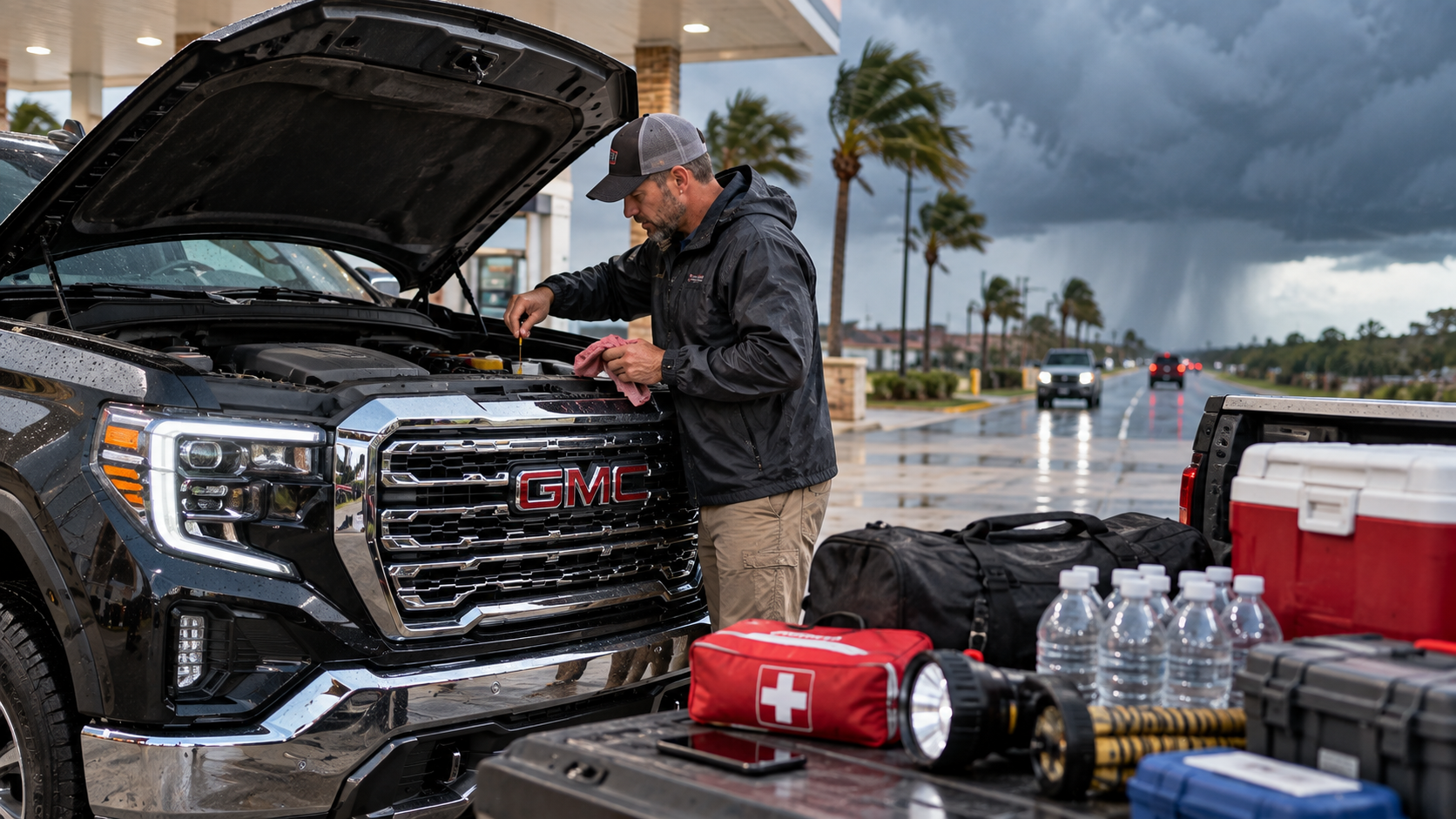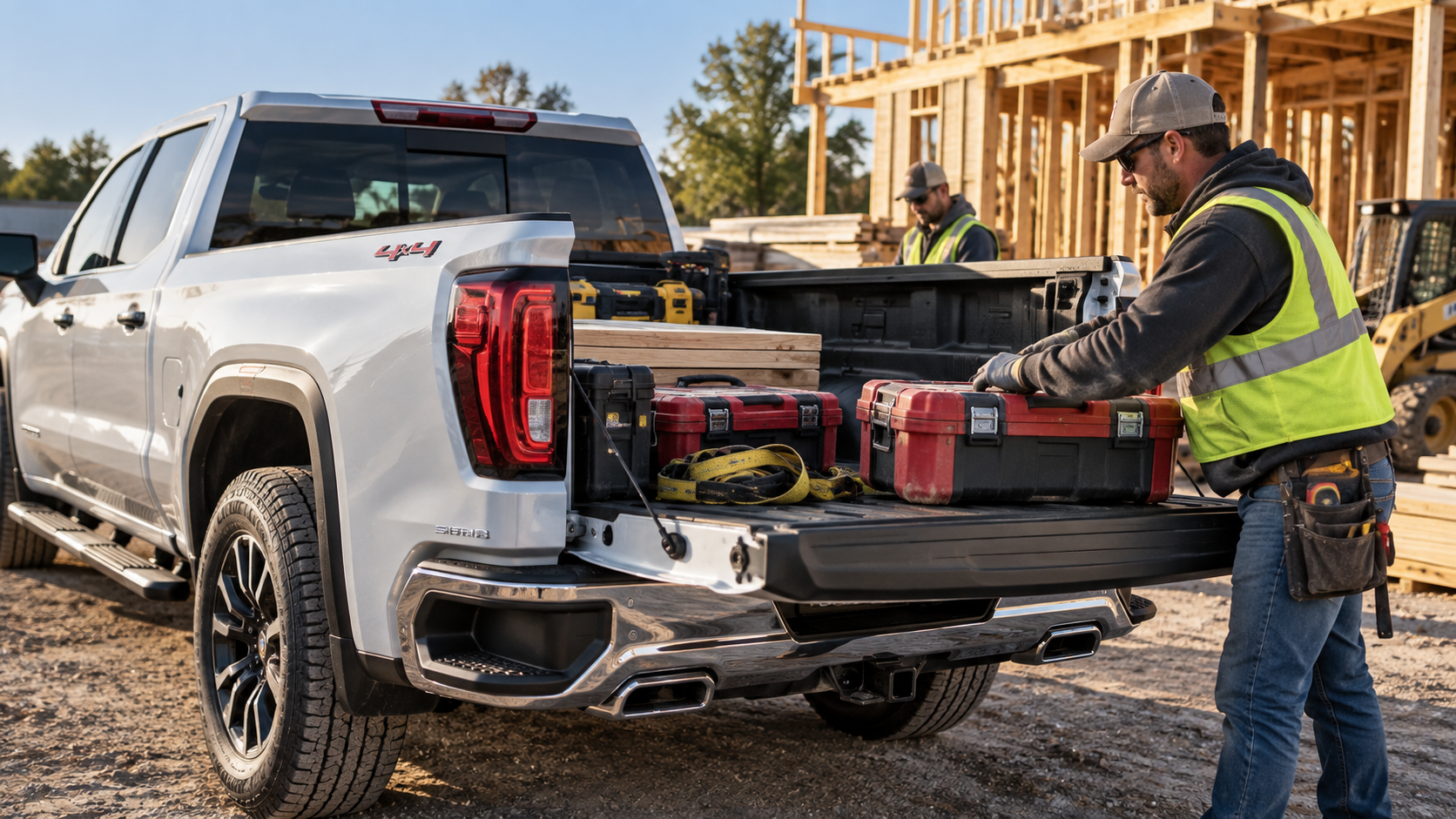



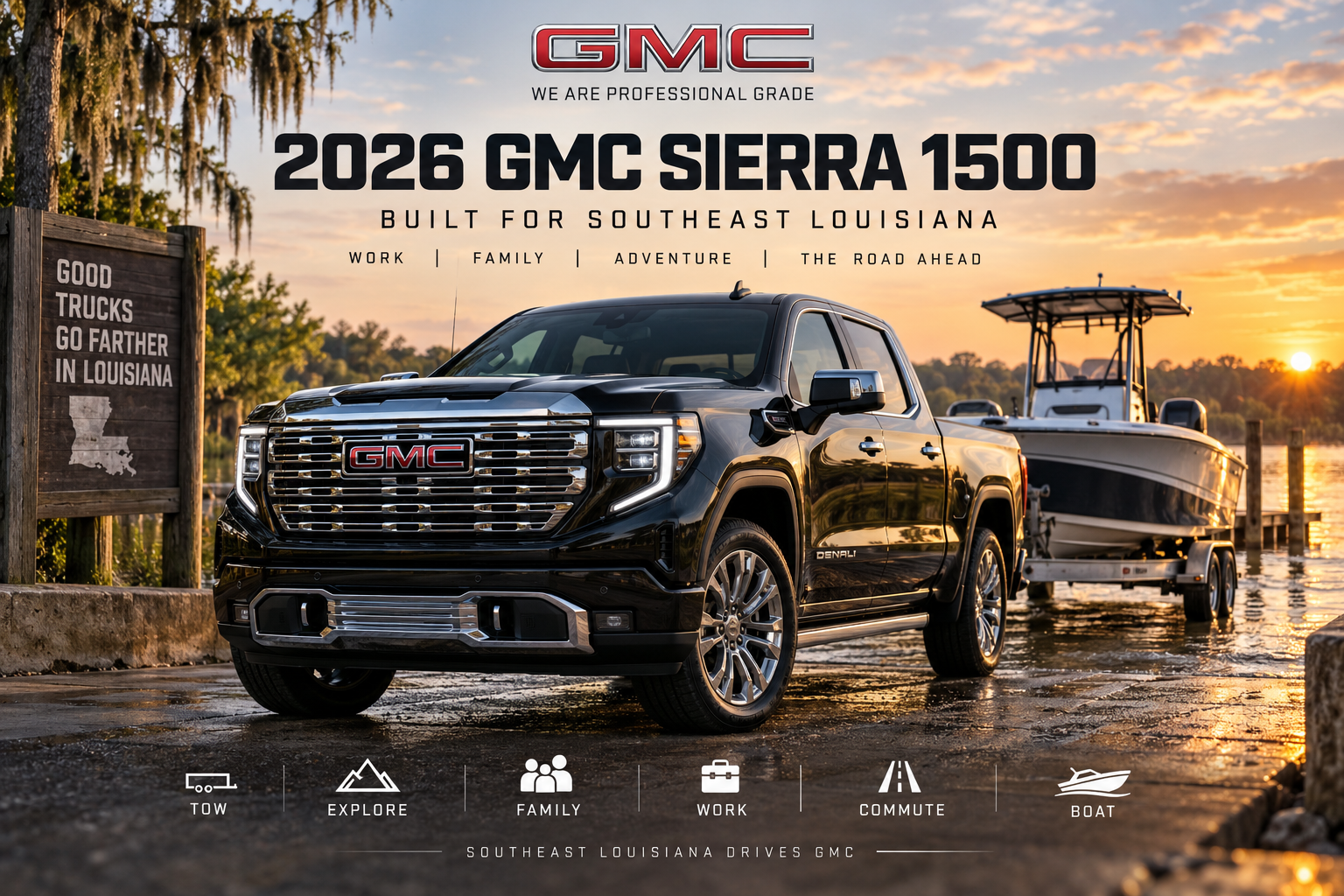
Shopping for a full-size truck in Southeast Louisiana means thinking about more than horsepower and appearance.
A truck here may need to handle daily commuting, tow a boat, carry equipment to a jobsite, travel rural roads, make regular trips along I-10 or I-12, or serve as the family vehicle on the weekend.
The 2026 GMC Sierra 1500 gives buyers a wide range of configurations, including multiple engines, cab styles, drivetrains and trim levels. Depending on configuration, shoppers can choose from work-focused models such as the Sierra Pro, off-road-oriented trims such as the AT4 and AT4X, and luxury-focused models such as Denali and Denali Ultimate.
For truck shoppers in Hammond, Gonzales, Baton Rouge, Prairieville, Denham Springs, Covington, Mandeville, Slidell, Livingston Parish, Tangipahoa Parish, Ascension Parish and surrounding Southeast Louisiana communities, this guide explains the Sierra 1500 features and configurations worth comparing.
Is the 2026 GMC Sierra 1500 a Good Truck for Southeast Louisiana?
The 2026 GMC Sierra 1500 is worth considering for Louisiana drivers who want a full-size pickup that can combine everyday comfort with towing capability, available four-wheel drive, useful cargo-bed configurations and premium technology.
Depending on trim and equipment, the Sierra 1500 offers:
- Multiple gasoline and diesel engine choices
- Up to 13,300 pounds of available maximum diesel towing capacity when properly equipped
- Crew Cab, Double Cab and Regular Cab configurations
- Available 2WD and 4WD
- Available GMC MultiPro Tailgate
- Available Super Cruise driver-assistance technology
- AT4 and AT4X off-road-oriented models
- Denali and Denali Ultimate luxury-focused models
GMC lists the maximum available diesel towing capacity for the 2026 Sierra 1500 at 13,300 pounds when properly equipped. That rating applies only to specific configurations and should not be assumed to apply to every Sierra 1500.
Trailering Note: Maximum trailering ratings vary by vehicle configuration, equipment, passengers, cargo and other factors. Always review the specific vehicle's trailering information, labels and owner's manual before towing.
What Engines Are Available in the 2026 GMC Sierra 1500?
The 2026 Sierra 1500 is available with several powertrain choices, giving buyers the ability to prioritize everyday driving, traditional V8 performance, towing or diesel capability.
TurboMax Engine
The TurboMax engine produces:
310 horsepower
430 lb-ft of torque
GMC lists maximum available towing of up to 9,400 pounds when properly equipped for certain TurboMax configurations.
For drivers who primarily commute, handle home projects, carry equipment or tow moderate loads, the TurboMax may be a useful configuration to compare.
5.3L EcoTec3 V8
The available 5.3-liter V8 gives Sierra buyers a traditional gasoline V8 option.
It is standard on certain trims, including the 2026 Sierra 1500 SLT, where GMC pairs it with a 10-speed automatic transmission.
This engine may appeal to shoppers who want familiar V8 characteristics while balancing everyday driving and truck capability.
6.2L V8
The available 6.2-liter V8 is offered in selected Sierra 1500 configurations and is especially relevant to shoppers considering higher-content trims.
It may be worth comparing if stronger gasoline-engine performance is an important part of the buying decision.
3.0L Duramax Turbo-Diesel
The available 3.0L Duramax Turbo-Diesel is especially relevant for buyers who regularly tow or spend substantial time on the highway.
When properly configured, a 2026 Sierra 1500 equipped with the Duramax can achieve GMC's maximum advertised towing rating of up to 13,300 pounds.
Which GMC Sierra 1500 Engine Is Best for Louisiana?
There is no single engine that is best for every Louisiana driver.
The more useful question is:
How will you actually use the truck?
Consider the TurboMax if:
You primarily commute, drive locally, carry moderate loads or occasionally tow.
Consider the 5.3L V8 if:
You want a traditional gasoline V8 and a balance of everyday usability and capability.
Consider the 6.2L V8 if:
You prefer stronger gasoline-engine performance and are considering compatible Sierra configurations.
Consider the 3.0L Duramax if:
You tow frequently, drive substantial highway mileage or specifically prefer a diesel powertrain.
For many buyers, choosing the right engine and capability package first can be more important than choosing a trim based on appearance alone.
How Much Can a 2026 GMC Sierra 1500 Tow?
The 2026 Sierra 1500 can tow up to 13,300 pounds when properly equipped, according to GMC.
That number does not apply to every Sierra 1500.
GMC states that the maximum rating is achieved with a specific configuration that includes a Double Cab, 2WD, standard bed, available 3.0L Duramax Turbo-Diesel, available Max Trailering Package and specified wheels and tires.
Actual capability varies based on factors such as:
- Engine
- Cab configuration
- Bed length
- 2WD or 4WD
- Trailering equipment
- Wheel and tire configuration
- Optional equipment
- Passenger and cargo weight
What Should You Know Before Buying a Sierra for Towing?
If towing is one of the main reasons you are buying a truck, start by understanding the trailer you plan to pull.
Know the:
Loaded trailer weight
Tongue weight
Payload requirements
Passenger weight
Cargo weight
Required hitch type
Then compare those needs with the ratings for the specific truck you are considering.
A model-line maximum should never be treated as the towing rating for every vehicle bearing the Sierra 1500 name.
Is the Duramax Sierra 1500 Good for Towing Boats in Louisiana?
The 3.0L Duramax Sierra 1500 can be a strong configuration to consider for drivers who regularly tow.
That may include Louisiana boat owners hauling:
- Bass boats
- Bay boats
- Center-console boats
- Pontoon boats
- Fishing boats
- Utility trailers
- ATVs or side-by-sides
The right configuration depends on the actual loaded weight of the boat, trailer, fuel and equipment.
Always compare that weight against the trailering and payload information for the specific Sierra 1500 you are considering.
What 2026 GMC Sierra 1500 Trims Are Available?
The 2026 Sierra 1500 lineup includes:
Pro
SLE
Elevation
SLT
AT4
AT4X
Denali
Denali Ultimate
That range allows shoppers to prioritize work capability, appearance, off-road equipment, luxury or a combination of those factors.
GMC Sierra 1500 Pro: Who Should Consider It?
The Sierra Pro is the work-focused entry point into the lineup.
It may be a logical starting point for:
- Contractors
- Fleet operators
- Small businesses
- Property owners
- Agricultural users
- Buyers who prioritize utility
It is also available in Regular Cab configurations, which may appeal to buyers who do not need a second row.
GMC Sierra 1500 SLE: A Well-Equipped Everyday Truck
The SLE adds many of the technology and comfort features buyers expect in a modern personal-use pickup.
Depending on equipment, shoppers can find features such as GMC's large infotainment display and digital Driver Information Center.
The 3.0L Duramax Turbo-Diesel is also available on applicable SLE configurations.
For someone who wants an everyday Sierra with more technology and convenience features than a basic work truck, the SLE is worth comparing.
GMC Sierra 1500 Elevation: A Popular Style-Focused Choice
The Sierra Elevation emphasizes a more distinctive appearance while retaining everyday truck usability.
Standard exterior features include elements such as:
- Monochromatic exterior treatment
- Gloss-black grille details
- LED fog lamps
- 20-inch gloss-black painted aluminum wheels
For shoppers who want aggressive styling without automatically moving into an off-road or luxury-focused trim, the Elevation may be a useful model to compare.
GMC Sierra 1500 SLT: Premium Features with Traditional Truck Character
The 2026 SLT includes the 5.3L V8 as standard equipment and offers additional convenience and premium features.
The available Duramax diesel and trailering technology can make the SLT worth considering for buyers who want a well-equipped truck without moving into Denali territory.
Is the GMC Sierra AT4 a Good Choice for Louisiana?
The Sierra AT4 is designed for buyers who want additional off-road-oriented equipment.
Standard equipment includes features such as:
- 2-inch factory suspension lift
- Off-road suspension
- Rancho monotube shocks
- Two-speed transfer case
- Underbody skid plates
- Automatic locking rear differential
The 3.0L Duramax Turbo-Diesel is standard on the 2026 AT4.
Those features may be useful for drivers who regularly travel:
- Hunting property
- Camps
- Gravel roads
- Rural property
- Muddy worksites
- Boat launches
- Unimproved roads
What Is the Difference Between Sierra AT4 and AT4X?
The AT4 and AT4X are both off-road-oriented Sierra trims, but the AT4X adds more specialized equipment.
Depending on configuration, the AT4X includes features such as:
- Multimatic DSSV dampers
- Front electronic locking differential
- Rear electronic locking differential
- Additional underbody protection
For buyers who mainly want meaningful off-road capability while retaining everyday usability, AT4 may be worth comparing first.
For those who place greater emphasis on specialized off-road hardware, AT4X may deserve additional consideration.
GMC Sierra Denali: Who Should Consider It?
Sierra Denali combines full-size pickup capability with a more luxury-focused interior and exterior.
Depending on configuration, features include:
- Signature Denali exterior styling
- Genuine wood interior trim
- Aluminum trim
- Leather seating surfaces
- Power-adjustable front seats
- Available advanced driver-assistance technology
It may be particularly appealing to drivers who use their truck for both professional and personal transportation.
What Is Sierra Denali Ultimate?
Denali Ultimate sits at the top of the Sierra 1500 trim range.
Equipment includes features such as:
- 6.2L V8
- Super Cruise
- Heated and ventilated front seats
- Massage functionality
- Premium Bose audio
- Distinctive Denali Ultimate interior and exterior treatments
The 3.0L Duramax Turbo-Diesel is also available in applicable configurations.
For buyers prioritizing luxury, technology and premium interior appointments, it is worth comparing Denali Ultimate with Denali to determine whether the added equipment matches their needs.
Crew Cab vs. Double Cab vs. Regular Cab
Cab configuration can significantly affect passenger space and how the truck is used.
Crew Cab
Crew Cab is generally the configuration to compare first for:
- Families
- Frequent rear-seat passengers
- Road trips
- Daily commuting
- Buyers prioritizing passenger room
GMC lists approximately 43.4 inches of second-row legroom in the Crew Cab.
Double Cab
Double Cab may make sense for buyers who want four doors and rear seating but do not require as much second-row space.
GMC lists approximately 35.24 inches of second-row legroom in the Double Cab.
Regular Cab
Regular Cab configurations may be worth considering for dedicated work use when rear seating is unnecessary.
2WD or 4WD Sierra 1500: Which Makes More Sense in Southeast Louisiana?
The right drivetrain depends on how and where you drive.
A 2WD Sierra may make sense if:
Most of your driving takes place on paved roads and highways and you rarely encounter low-traction conditions.
A 4WD Sierra may be worth considering if:
You frequently travel to:
- Hunting leases
- Camps
- Farms
- Construction sites
- Muddy property
- Gravel roads
- Boat launches
- Unimproved roads
Drivetrain selection can also affect towing, payload, fuel consumption and vehicle price, so it should be treated as a functional decision rather than simply an appearance preference.
Is the GMC MultiPro Tailgate Useful?
The available GMC MultiPro Tailgate offers multiple positions intended to improve bed access and cargo usability.
Depending on how the truck is used, it can assist with:
- Accessing the bed
- Loading equipment
- Managing longer cargo
- Creating a work surface
- Organizing items in the bed
For buyers who use their pickup bed frequently, tailgate functionality may deserve as much attention as interior technology.
What Technology Does the 2026 Sierra 1500 Offer?
Depending on trim and equipment, available Sierra technology includes:
- 13.4-inch infotainment display
- 12.3-inch Driver Information Center
- Head-Up Display
- Google built-in compatibility
- Trailering technologies
- Camera views
- Wireless phone connectivity
- Super Cruise driver-assistance technology
GMC states that available Sierra configurations offer more than 40 diagonal inches of combined driver-focused digital display area.
What Is Super Cruise on the GMC Sierra?
Super Cruise is GMC's available hands-free driver-assistance technology for compatible roads and operating conditions.
It is available on certain Sierra configurations and included on Denali Ultimate.
Super Cruise is a driver-assistance system, not an autonomous-driving system. Drivers must remain attentive, follow system requirements and remain responsible for vehicle operation at all times.
Which Sierra 1500 Is Worth Comparing for Commuting Between Hammond and Baton Rouge?
For frequent highway driving, shoppers may want to prioritize:
- Comfortable seating
- Crew Cab passenger space
- Engine choice
- Driver-assistance features
- Highway-oriented tires
- Infotainment technology
- Fuel consumption
Depending on budget and desired equipment, Elevation, SLT and Denali may all be worth comparing.
Buyers who accumulate substantial highway mileage may also want to compare the 3.0L Duramax with gasoline configurations based on their actual driving habits.
Which Sierra 1500 Should Frequent Towers Compare?
Buyers who tow frequently may want to compare several configurations.
3.0L Duramax
Worth considering for frequent or heavier conventional towing.
5.3L V8
A traditional gasoline option available across multiple configurations.
6.2L V8
Worth comparing for buyers who prefer stronger gasoline-engine performance.
The engine alone does not determine towing capability.
Cab style, drivetrain, bed length, trailering equipment and other options all influence the rating for an individual truck.
Which Sierra 1500 Is Worth Comparing for Hunting or Camp Use?
For many Louisiana buyers, the AT4 may be a logical starting point.
Its factory lift, 4WD-oriented hardware, skid plates and off-road suspension may provide useful capability for hunting property, camps and rural roads.
For more demanding terrain, shoppers may also want to compare the AT4X and its additional off-road hardware.
Which Sierra 1500 Is Worth Comparing for Contractors?
For dedicated fleet or work use, Sierra Pro is a logical starting point.
For mixed professional and personal use, SLE, Elevation or SLT may be worth comparing.
For owners or managers who place greater emphasis on premium interior appointments, Denali may also make sense.
The most suitable configuration depends on payload needs, towing requirements, passenger use and equipment preferences.
Which Sierra 1500 Is Worth Comparing for Families?
For families, a Crew Cab is generally the first configuration worth evaluating because it provides more rear-seat room than the Double Cab.
GMC lists approximately 43.4 inches of second-row legroom in Crew Cab models compared with 35.24 inches in Double Cab models.
Possible starting points include:
Family + everyday driving: Elevation
Family + frequent towing: Duramax Crew Cab
Family + off-pavement use: AT4 Crew Cab
Family + premium comfort: Denali Crew Cab
These are starting points rather than universal recommendations.
Sierra Elevation vs. AT4: Which Should You Compare?
Consider Elevation if your priorities are mainly:
- Styling
- Daily driving
- Technology
- Everyday usability
Consider AT4 if your priorities include:
- 4WD capability
- Hunting property
- Camps
- Off-pavement travel
- Factory lift
- Underbody protection
The best choice depends on whether the AT4's additional off-road equipment is useful for the way you actually drive.
Sierra AT4 vs. Denali: What's the Difference?
These trims emphasize different priorities.
AT4
More focused on off-road-oriented capability and rugged styling.
Denali
More focused on luxury, interior materials, comfort and technology.
A driver who regularly travels camp roads or rural property may place greater value on AT4 equipment.
A driver spending most of their time on highways and paved roads may prioritize the comfort and interior treatment of Denali.
Sierra Denali vs. Denali Ultimate
Denali provides a high level of premium equipment.
Denali Ultimate adds additional technology, seating features and distinctive design details.
The better choice depends on whether those additional features provide enough value for the individual buyer.
Should You Buy a Gas or Diesel GMC Sierra 1500 in Louisiana?
Start with four questions:
How much do you tow?
How often do you tow?
How much highway driving do you do?
How long do you plan to keep the truck?
The Duramax may become more attractive when towing and highway use are major parts of ownership.
For buyers primarily making shorter local trips with lighter towing needs, a gasoline engine may be worth comparing first.
There is no universal rule that diesel is automatically the better choice.
What Should You Check During a Sierra 1500 Test Drive?
A useful test drive should involve more than driving around the block.
Pay attention to:
Visibility
Can you comfortably judge the truck's dimensions?
Seat Position
Are you comfortable behind the wheel?
Rear-Seat Space
If passengers will regularly ride in the back, sit there yourself.
Ride Quality
Compare trims if possible, especially conventional models versus AT4 or AT4X.
Engine Response
Drive the engine you are actually considering.
Parking
Try backing into a parking space and using the available camera systems.
Technology
Connect your phone and use the infotainment system.
Bed Access
Open the tailgate and see how easy it is to access the cargo bed.
Questions to Ask Before Buying a GMC Sierra 1500
Before choosing a particular truck, ask:
- What exact engine does this truck have?
- Is it 2WD or 4WD?
- What cab configuration does it have?
- What bed length does it have?
- What is this specific truck's trailering rating?
- What is its payload rating?
- Does it have the Max Trailering Package?
- Which driver-assistance features are included?
- Does it have the MultiPro Tailgate?
- Are dealer-installed accessories included?
- Which factory warranties apply?
- Are any available incentives subject to eligibility requirements?
These questions make it easier to compare individual trucks accurately.
Frequently Asked Questions About the 2026 GMC Sierra 1500
How much can a 2026 GMC Sierra 1500 tow?
The 2026 Sierra 1500 can tow up to 13,300 pounds when properly equipped. Actual towing capacity varies by configuration.
Which Sierra engine provides the highest advertised maximum towing capacity?
The available 3.0L Duramax Turbo-Diesel is used in the Sierra 1500 configuration that achieves GMC's maximum advertised rating of up to 13,300 pounds when properly equipped.
How much can the TurboMax Sierra 1500 tow?
GMC lists maximum available towing of up to 9,400 pounds when properly equipped for certain TurboMax configurations.
Does the Sierra 1500 offer a V8?
Yes. Applicable 2026 Sierra 1500 configurations are available with 5.3L and 6.2L V8 engines.
Does the Sierra 1500 offer a diesel engine?
Yes. The available 3.0L Duramax Turbo-Diesel is offered on multiple Sierra 1500 configurations.
Does the Sierra AT4 come with the Duramax diesel?
Yes. The 3.0L Duramax Turbo-Diesel is standard on the 2026 Sierra 1500 AT4.
What is the difference between Sierra AT4 and AT4X?
The AT4X adds more specialized off-road hardware, including Multimatic DSSV dampers and front and rear electronic locking differentials.
What is the most premium Sierra 1500 trim?
Denali Ultimate sits at the top of the 2026 Sierra 1500 trim range.
Does the Sierra 1500 offer Super Cruise?
Yes. Super Cruise is available on certain Sierra configurations and included on Denali Ultimate. It remains a driver-assistance technology and does not replace driver attention or responsibility.
Which Sierra cab has the most rear-seat space?
The Crew Cab provides more rear-seat legroom than the Double Cab. GMC lists approximately 43.4 inches for Crew Cab versus 35.24 inches for Double Cab.
Can a Sierra 1500 tow a camper?
Many configurations can tow recreational trailers, but buyers should compare the camper's loaded weight and tongue weight with the specific truck's trailering and payload ratings.
Can a Sierra 1500 tow a fifth-wheel or gooseneck trailer?
Certain configurations can. GMC lists maximum available fifth-wheel/gooseneck towing of up to 9,900 pounds when properly equipped for a specific 2026 configuration.
Is 2WD or 4WD better for Louisiana?
That depends on usage. Buyers who primarily drive paved roads may find 2WD sufficient, while drivers who regularly visit camps, hunting leases, muddy jobsites or unimproved roads may prefer 4WD.
Which Sierra 1500 trim offers a good balance of styling and everyday usability?
The Elevation is one configuration worth comparing because it combines distinctive styling with features aimed at personal-use truck buyers. The best trim still depends on budget and intended use.
Finding the Right GMC Sierra 1500 in Southeast Louisiana
The smartest way to shop for a Sierra 1500 is not simply to ask:
“Which Sierra is best?”
A better question is:
“Which Sierra best matches the way I actually use a truck?”
A contractor in Hammond may need a very different configuration from a commuter in Prairieville.
A boat owner in Gonzales may prioritize trailering equipment and engine choice.
A hunter heading to camp may place more value on AT4 equipment.
A driver regularly traveling between Baton Rouge and the Northshore may prioritize interior comfort and highway technology.
And someone who tows frequently may care much more about engine, trailering equipment and payload than exterior trim.
That is why the engine, drivetrain, cab, bed and equipment package should be considered together.
Shopping for a GMC Sierra 1500 in Southeast Louisiana?
Start by identifying three things:
What you need to tow.
How you normally drive.
Which features you will actually use.
From there, compare available Sierra 1500 inventory by engine, cab, drivetrain, bed configuration and equipment.
That approach can make it much easier to identify a truck that fits the way you plan to use it throughout Southeast Louisiana.
Vehicle Information Disclaimer
Vehicle specifications, features, ratings, availability and equipment may vary by trim, configuration and individual vehicle and are subject to change by the manufacturer. Trailering and payload ratings vary based on vehicle configuration, equipment, passengers, cargo and operating conditions. Always review the specific vehicle's labels, owner's manual and manufacturer trailering information before towing. Images, examples and equipment descriptions may refer to optional or unavailable features. Contact a Ross Downing GMC representative for information regarding a specific vehicle.
This version also avoids the high-risk advertising areas the FTC is currently scrutinizing—such as misleading vehicle prices, unavailable rebates, required fees omitted from advertised pricing, required down payments, and financing-dependent advertised prices—because the article makes no pricing, payment, APR, savings or guaranteed-discount claims. Louisiana law likewise prohibits false or misleading dealership advertising, so keeping the piece factual, qualified and free of unsupported superlatives is the safer approach.