



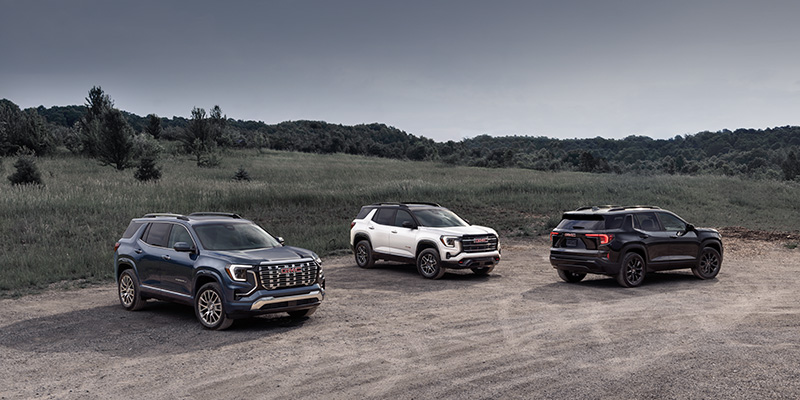
The GMC Terrain vs Acadia decision comes down to one structural question: how many passengers does your household carry regularly? Both are GMC crossovers. Both share a family-oriented feature set and the same dealer network. However, the Terrain is a compact two-row SUV and the Acadia is a midsize three-row SUV. That structural difference shapes every other comparison point between them.
Two Different Vehicle Categories
The Terrain and the Acadia are not the same vehicle at different sizes. Instead, they occupy different segments with different design priorities. The Terrain is built around two rows, a compact footprint, and fuel efficiency. The Acadia, by contrast, is built around three rows, a larger cargo floor, and the ability to move more passengers with more gear.
A buyer comparing the two on price alone misses the more important comparison. The Terrain starts at approximately $32,995. The Acadia starts at approximately $42,995. That $10,000 gap reflects a difference in vehicle category, not trim content. As a result, choosing between them based on budget without accounting for seating need creates a mismatch that no feature list resolves.
Seating and Passenger Capacity
The Terrain seats five passengers across two rows. The second row accommodates three passengers with adequate shoulder room for adults on shorter trips. For households that carry no more than five people, the Terrain covers every daily use case without the added length of a third row.
The Acadia seats seven passengers in its standard second-row bench configuration. That bench allows eight passengers, but third-row occupants must climb over a folded seat on trims without captain’s chairs. The third row suits passengers under 5’8″ on extended trips. Adult passengers in the third row will find legroom limiting after the first hour. For households with three or more children, or for buyers who transport more than five people regularly, the Acadia’s third row changes the vehicle’s function entirely.
Cargo Space
The Terrain delivers 29.6 cubic feet of cargo space behind the second row. With the second row folded, that number rises to 63.3 cubic feet. The Acadia delivers 15.6 cubic feet behind the third row, 41.7 cubic feet with the third row folded, and 79.2 cubic feet with both rows folded.
The Terrain’s cargo number behind the second row is larger than the Acadia’s number behind the third row. That gap matters for buyers who load the vehicle with all seats occupied. When the Acadia carries all seven passengers, it provides less usable rear cargo space than a fully loaded Terrain. The Acadia’s total cargo advantage only applies when the third row is folded. So for households that use all three rows regularly, the Terrain is the stronger daily cargo vehicle when all seats are in use.
Safety Tech Differences in the Denali Trims
Both the Terrain Denali and the Acadia Denali include GMC’s standard advanced driver assistance suite. That shared foundation covers automatic emergency braking, forward collision alert, lane keep assist, lane departure warning, blind zone steering assist, and rear cross-traffic braking. However, the safety tech differences between the two Denali trims go beyond that baseline.
The Acadia Denali adds intersection automatic emergency braking. That system detects cross-traffic threats at intersections where traditional forward collision sensors have limited angles. It also includes a safety alert seat that delivers haptic pulse warnings through the driver’s seat cushion. That addition means the driver receives alerts even when audio or visual warnings go unnoticed. Enhanced pedestrian detection and lane keep assist on curves are also part of the Acadia Denali’s broader suite.
The Terrain Denali includes HD surround vision, Smart Frequency dampers, and standard AWD. It also covers the full base driver assistance suite in a more compact package. For buyers who want the most comprehensive active safety coverage in either model, the Acadia Denali carries the wider suite. That difference reflects its role as a midsize SUV operating at full occupancy in higher-exposure environments.
Which Model Is Better for Towing
The Terrain tows up to 1,500 pounds across every trim. That rating covers small utility loads. It does not support boats, camper trailers, or travel trailers of substantial size. The Acadia, on the other hand, tows up to 5,000 pounds across every trim with the trailering package confirmed across all configurations.
That 3,500-pound difference defines the towing conversation entirely. A buyer who needs to tow a personal watercraft, a small camper, or a utility trailer above 1,500 pounds has one option in this comparison. The Acadia’s 2.5L turbo handles heavier structures and maintains highway passing power under load. The Terrain does not offer a towing upgrade path that closes that gap. Therefore, for towing, the Acadia is the only applicable choice between the two.
Which Model Is Better for Long Road Trips
For long road trips with more than five passengers, the Acadia is the stronger choice. The larger infotainment screen, additional powertrain reserve under highway load, and extra row all contribute to a less fatiguing long-distance drive. Families with children in a third row also benefit from the physical separation that the additional row creates on multi-hour trips.
The Terrain, however, is the stronger road trip vehicle for households of four or fewer. Its fuel efficiency advantage — up to 27 MPG highway versus the Acadia’s 25 MPG highway — extends the range between fuel stops. The shorter wheelbase also makes city navigation and parking at destinations more manageable. For a two-adult, two-child household covering 400 miles, the Terrain handles the trip without giving up anything the Acadia provides for that passenger count.


