


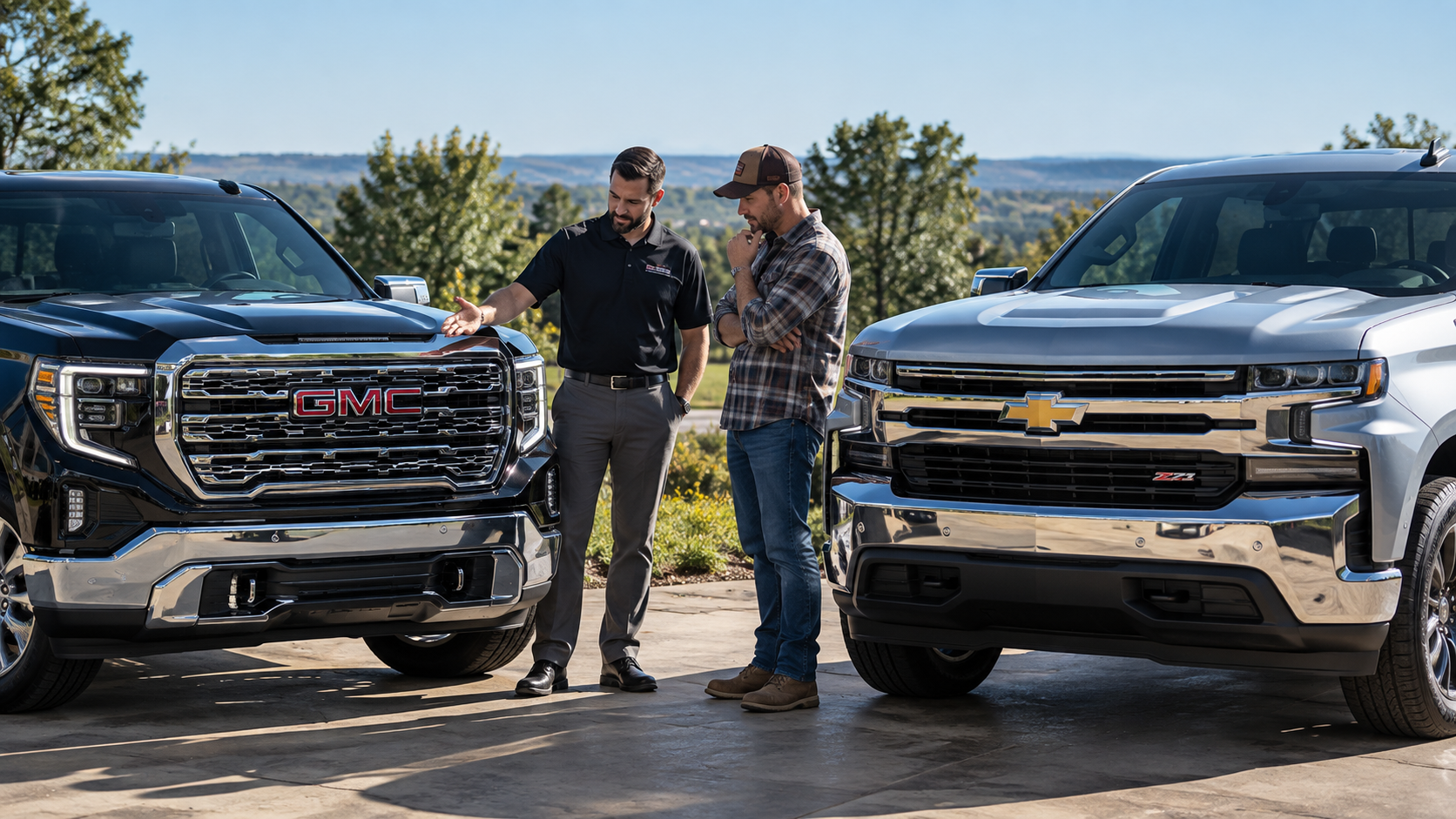
GMC Sierra vs Silverado comparisons start with two trucks that share major GM engineering. However, their trims and equipment take different paths. Both offer strong engine choices, useful trailering hardware, and a wide range of cab and bed setups. However, the details change as you move through each lineup. Therefore, the clearest way to compare them is to look at shared hardware first. Then, compare trims, cabin materials, off road equipment, and cargo features.
Start With What the Sierra and Silverado Share
The Sierra 1500 and Silverado 1500 share core GM truck engineering. That includes overlapping engine choices and related transmission pairings. So, are they the same truck? No. They start from a similar mechanical base, but each brand packages that hardware differently.
In addition, both lineups can offer turbocharged gasoline, V8 gasoline, and Duramax diesel power. Both trucks can be configured for towing, work, commuting, and long highway trips. Moreover, their cab and bed choices overlap in several areas.
Before comparing trim names, it helps to confirm the shared pieces:
- Both trucks can offer a 2.7 liter turbocharged gasoline engine, V8 choices, and a 3.0 liter Duramax diesel.
- Both lineups include rear wheel drive and four wheel drive configurations across multiple trims.
- Both trucks offer trailering technology, camera views, and bed focused equipment on selected trims.
Still, the trims do not line up perfectly. Therefore, two trucks with the same engine can feel very different inside. Equipment packages, materials, suspension hardware, and exterior details can change the final result.
Trim Structure Creates the First Major Difference
By contrast, GMC and Chevrolet use different trim ladders. That matters because trim names can make direct comparisons confusing. For this reason, a Sierra Elevation does not have a perfect Silverado twin. Likewise, upper trims can overlap in price while taking different styling and equipment paths.
GMC moves from Pro through SLE, Elevation, SLT, AT4, AT4X, Denali, and Denali Ultimate. Chevrolet uses names such as WT, Custom, LT, RST, LTZ, Trail Boss, ZR2, and High Country.
What should you compare first? Start with the job you want the truck to handle. Then, compare equipment inside that use case.
For GMC shoppers, these trim directions are useful:
- Pro and SLE focus on straightforward truck equipment with increasing comfort and convenience.
- Elevation adds a distinct street oriented look with more standard interior and technology content.
- AT4 and AT4X move toward off road hardware, while Denali trims focus on materials, comfort, and technology.
Chevrolet follows a different structure. Therefore, the strongest comparison is not trim name against trim name. It is equipment package against equipment package.
Denali and High Country Take Different Approaches
Meanwhile, Denali and High Country sit near the top of their lineups. Both add richer cabin materials and more standard features. However, GMC pushes the Denali identity through its own interior finishes, seat configurations, and exterior details.
Is Denali simply a different looking High Country? No. The two trims share some GM technology, but their cabin treatments and standard content differ. Sierra Denali uses its own leather treatments and trim details. Denali Ultimate moves further with upgraded front seating and massage functions.
In addition, High Country delivers an upscale cabin. However, Chevrolet uses its own materials, trim patterns, and feature packaging. Super Cruise can also appear on selected versions of both trucks. Therefore, it should not be treated as a GMC only feature.
The better comparison is to ask what matters inside the cabin. Seat adjustment range, material feel, display layout, audio equipment, and driver assistance features can all shape the final choice.
AT4 and AT4X Change the Off Road Comparison
Instead, GMC uses AT4 and AT4X to create a distinct off road path within the Sierra lineup. These trims add mechanical hardware that changes how the truck handles rough ground.
What does AT4 change beyond appearance? It adds equipment tied directly to trail use. That includes a factory lift, off road tuned shocks, skid plates, and a two speed transfer case. These parts change ground clearance and traction support before cosmetic details enter the decision.
Beyond that, AT4X goes further. It adds front and rear electronic locking differentials and Multimatic DSSV dampers. Therefore, it is built around more demanding terrain than a standard street focused trim.
Chevrolet follows a parallel path with Trail Boss and ZR2 trims. However, the hardware mix and trim structure are not identical. For that reason, compare suspension parts, locking hardware, tires, and underbody protection before comparing badges.
Choose Based on Equipment Instead of the Badge
The Sierra and Silverado share enough hardware that brand alone should not decide the truck. Instead, compare the equipment that shapes how you plan to use it.
Therefore, start with engine choice and towing needs. Then, compare cabin materials, off road hardware, cargo tools, and technology. In addition, review which features are standard and which require packages.
Before choosing, compare these areas:
- Engine and drivetrain choices that match your towing, commuting, or work needs.
- Cabin materials, seating, displays, and driver assistance features on the trims you are considering.
- Cargo features, tailgate design, bed materials, suspension hardware, and off road equipment.
In addition, GMC offers Sierra specific options such as the available CarbonPro bed. Chevrolet offers its own related cargo and tailgate features. Therefore, small equipment differences can matter more than the badge on the grille.
With that in mind, build a side by side comparison around matching configurations. Use the same engine class, similar cab and bed setups, and similar trim goals. Then, compare price and included equipment. That process gives you a cleaner view of what each truck offers for your needs.
Explore current GMC inventory at Ross Downing GMC of Gonzales to compare available Sierra configurations and equipment.